Announcing The Jasper Project's 2026 Gallery Schedule

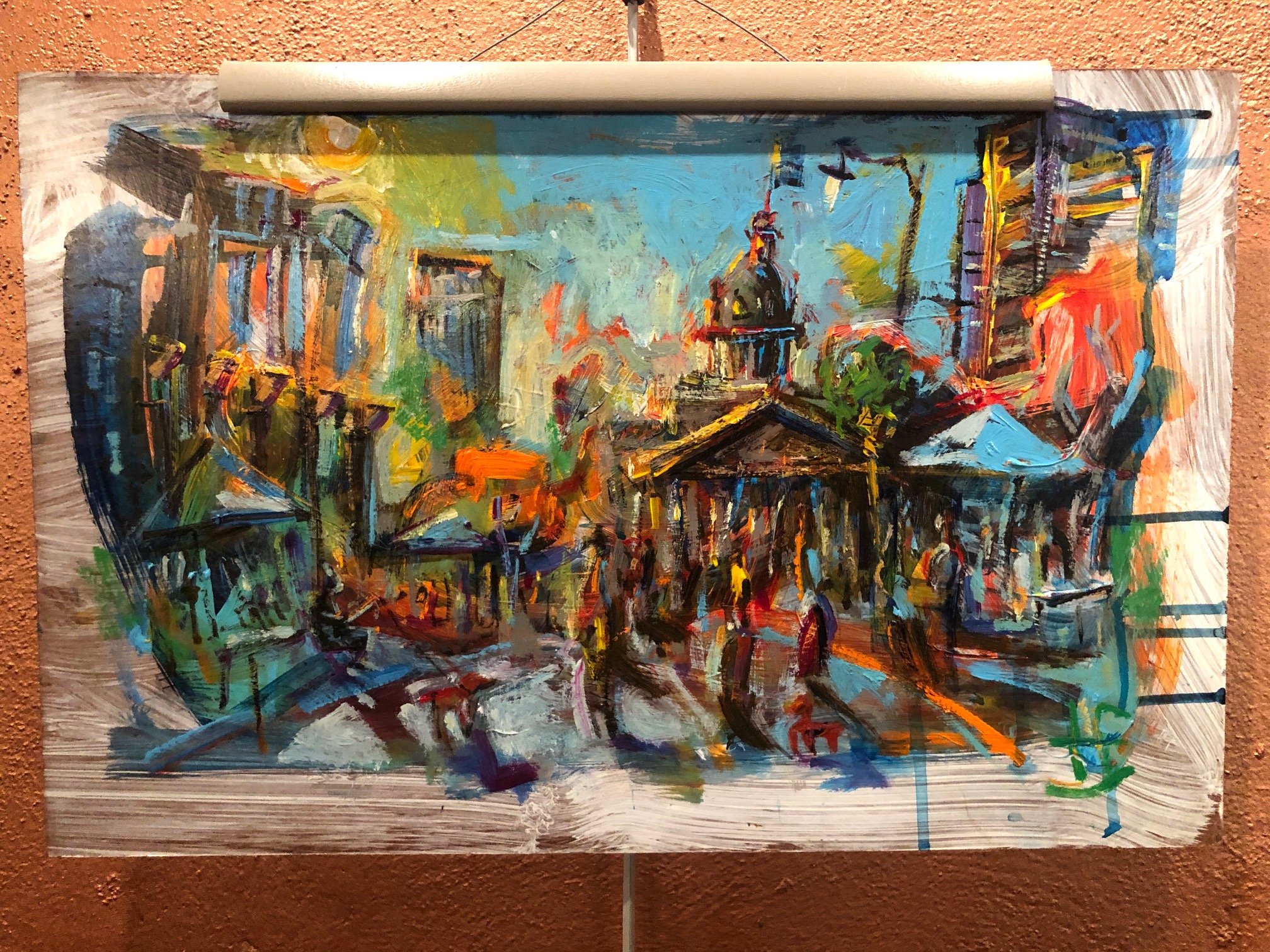
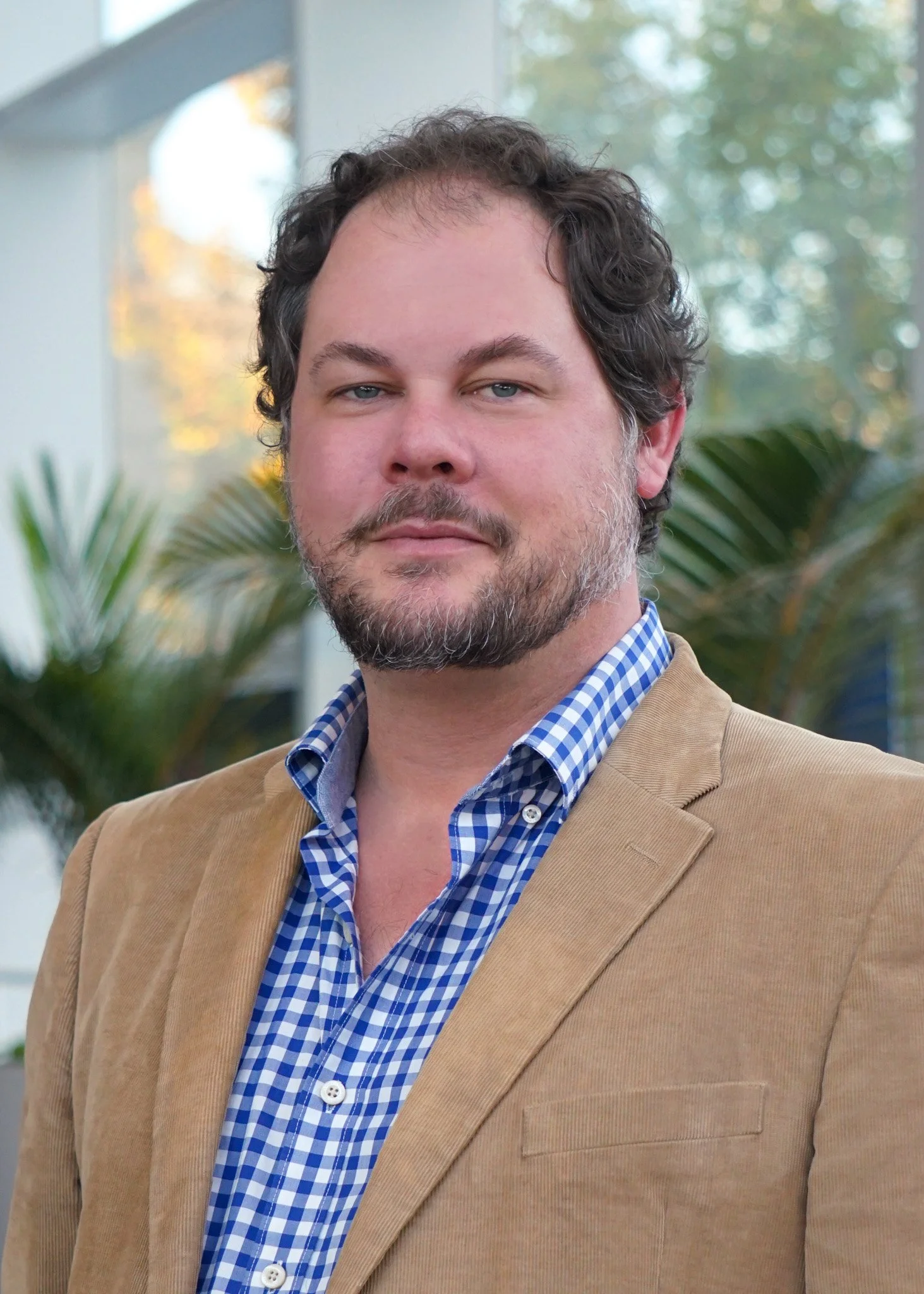
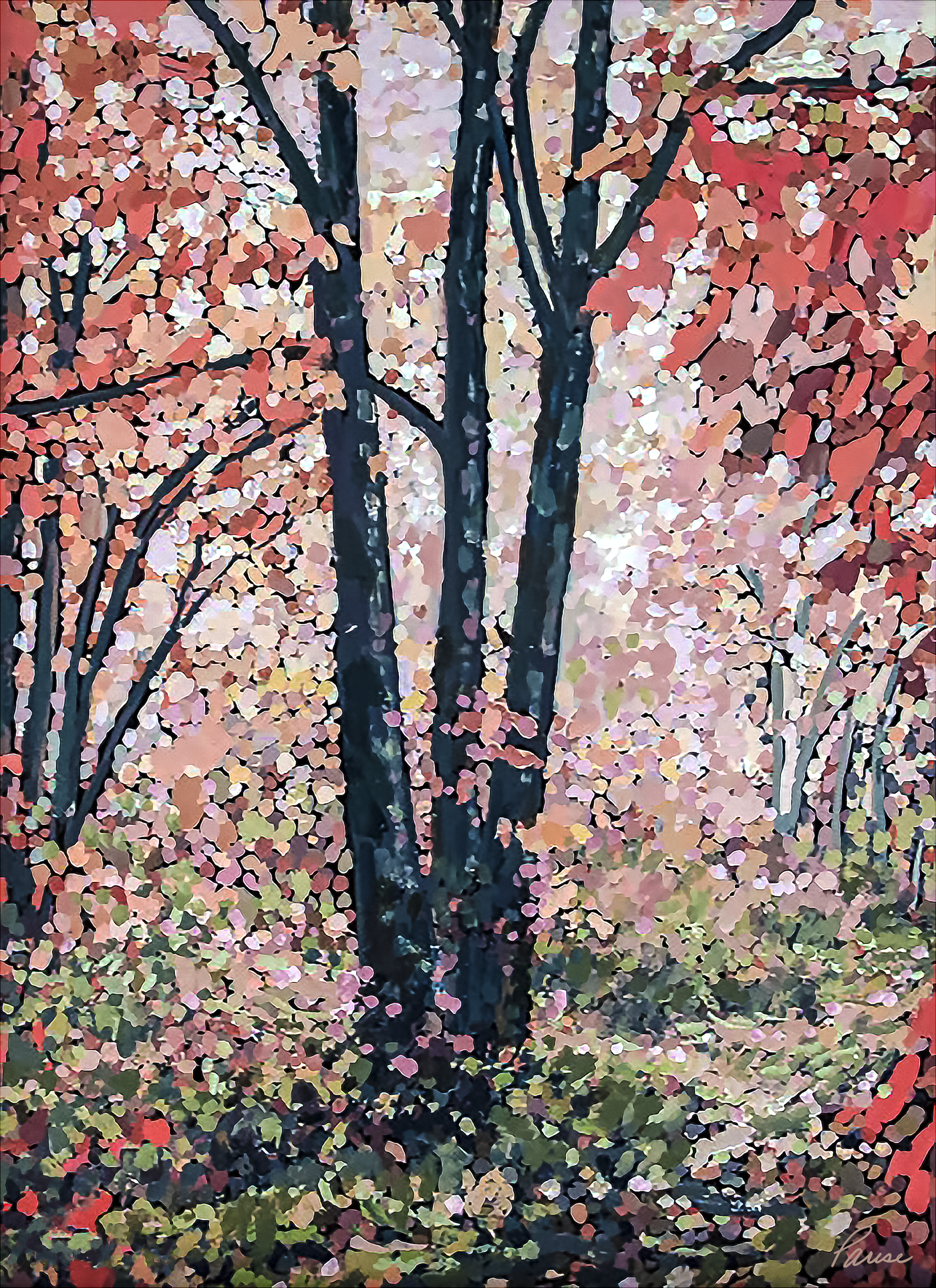
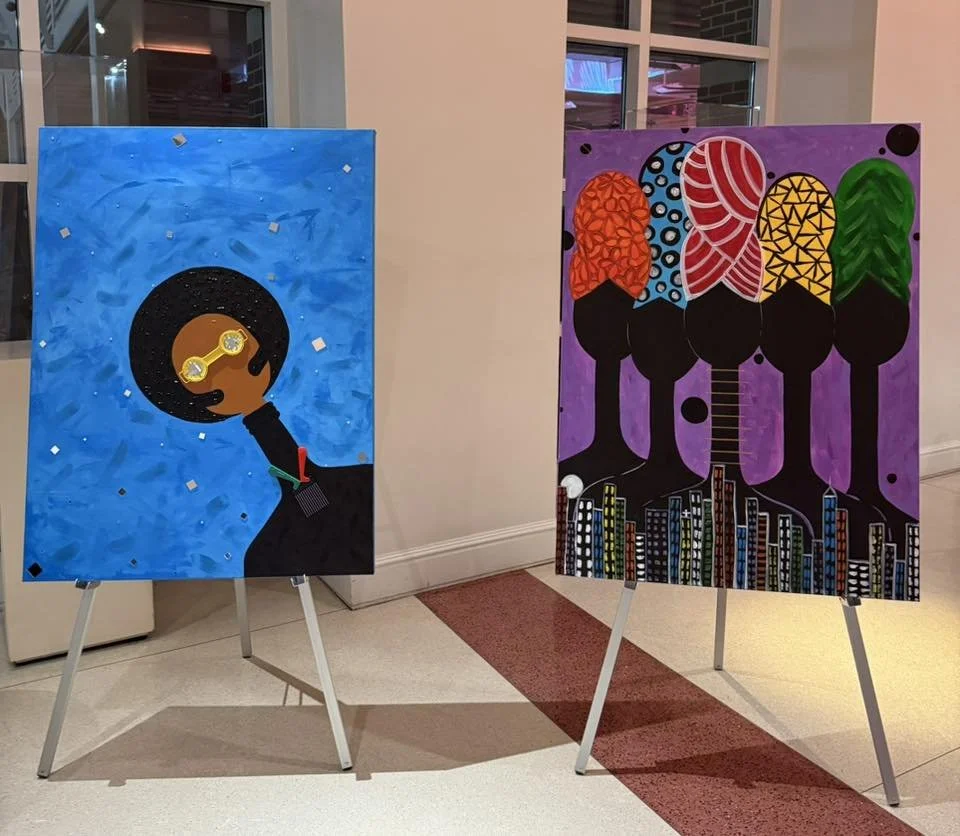
Artist - Patrick Parise

For those of us here at The Jasper Project, one of our most satisfying ongoing projects is the monthly and quarterly rotation of artists and their work through our gallery spaces across town. Through the generosity and hospitality of restaurant owners, leadership at the Koger Center and Harbison Theatre, and the management at the Meridian Building downtown, we have been able to arrange for the showing of hundreds of Midlands area artists over the years. For some of our artists, The Jasper Project has guided them through their very first showing. This is a wonderful thing to have the privilege of experiencing and we appreciate our artists trusting us with this honor. And once an artist has shown their work with us, it seems we always become dear friends with both them and their entourage, whether it be family members, longtime supporters, or old friends who come out to cheer them on. Yes, programming, promoting, and handling all the paperwork involved in putting art on walls about town is time-consuming and arduous work. But it’s all worth it when we see the joy and pride on the faces of artists once their exhibition is open and on view.

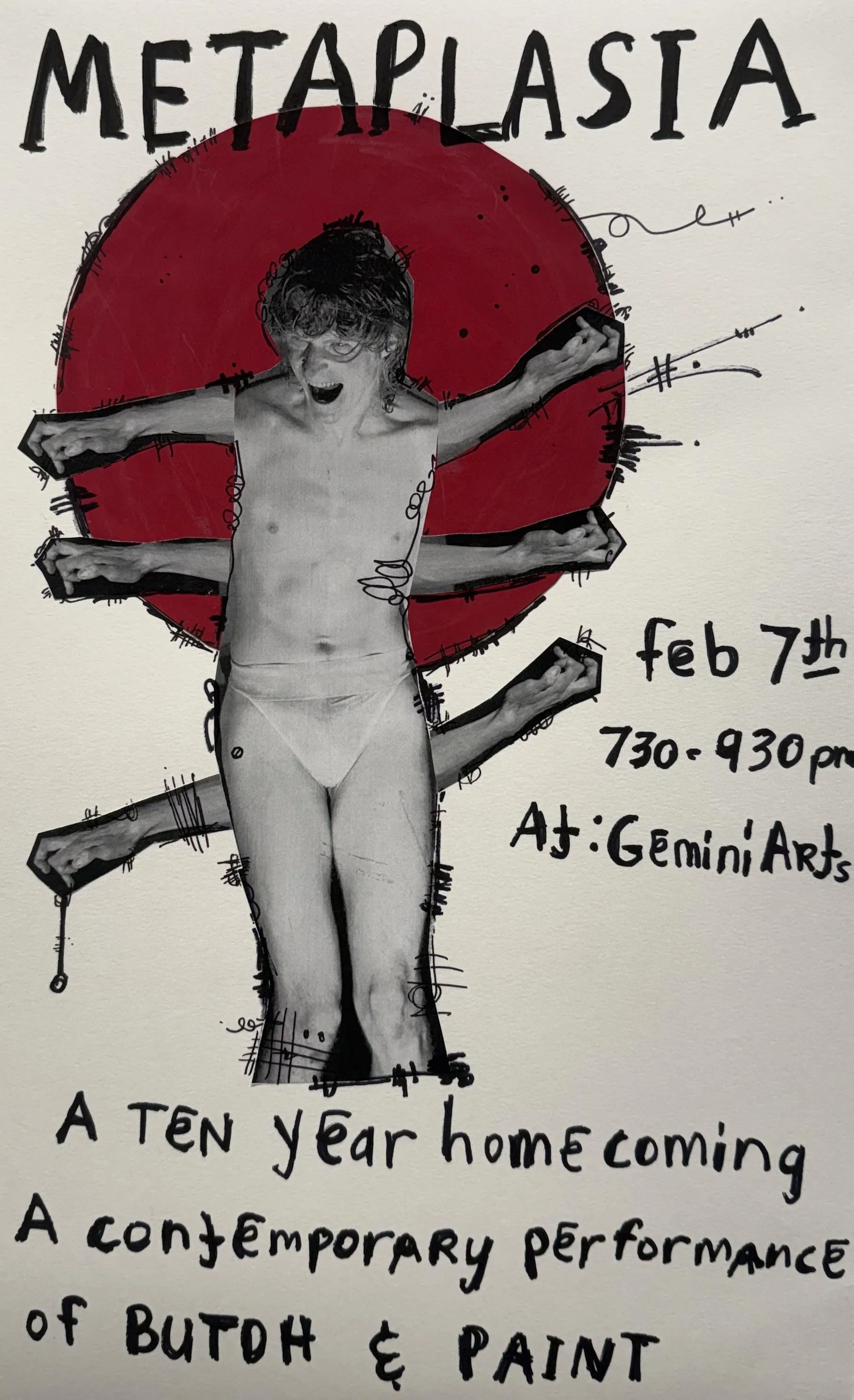
For 2026, our team has assembled another 40+ individual artists who will exhibit their work in our designated galleries. (This does not include the visual artists we work with in our one-off projects, such as Degenerate Art II and the Peter Lenzo retrospective, coming up this spring at Gemini Arts and Stormwater respectively.)

Without further ado, we are delighted to announce The Jasper Project’s 2026 schedule of exhibiting artists!

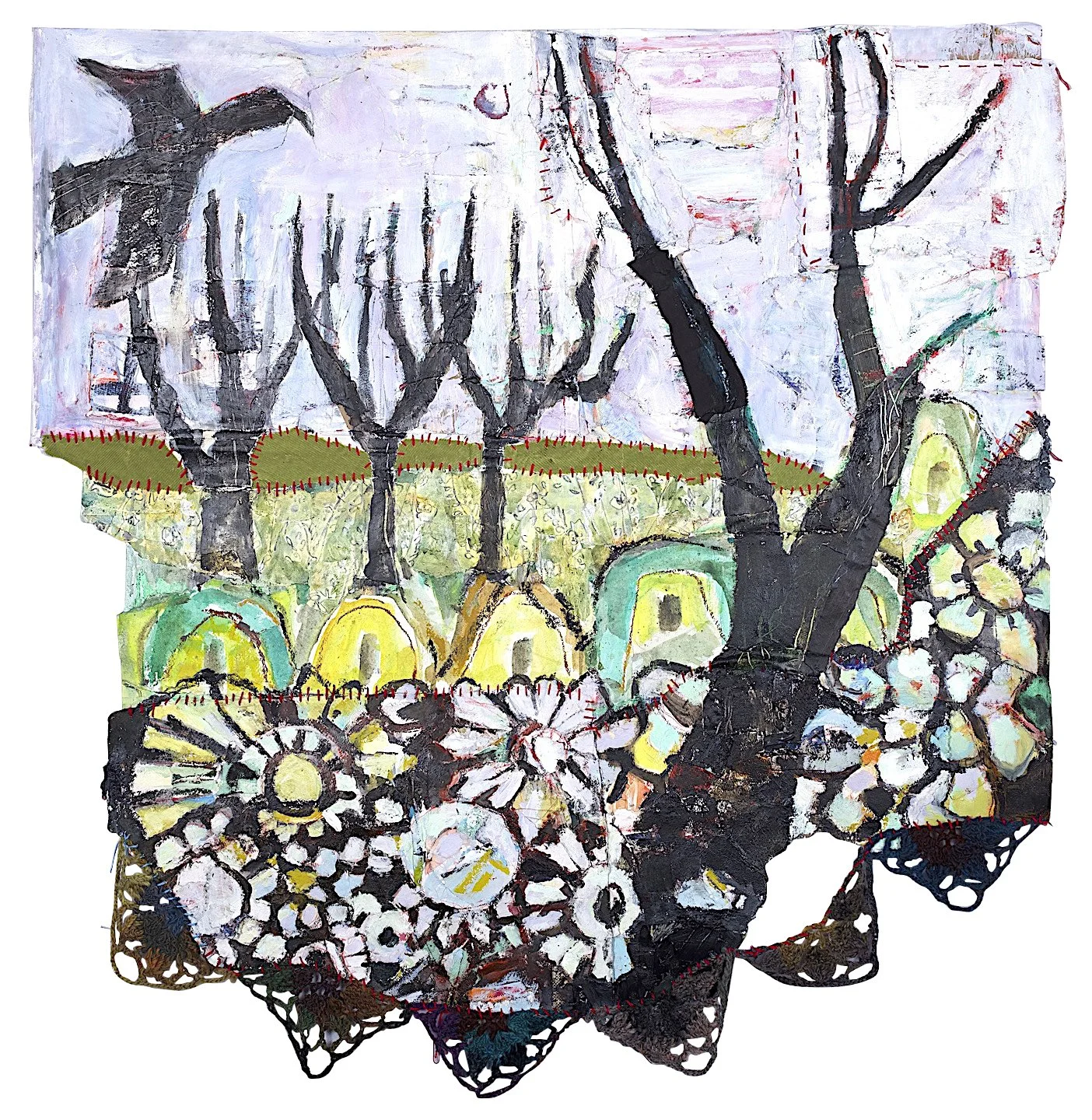
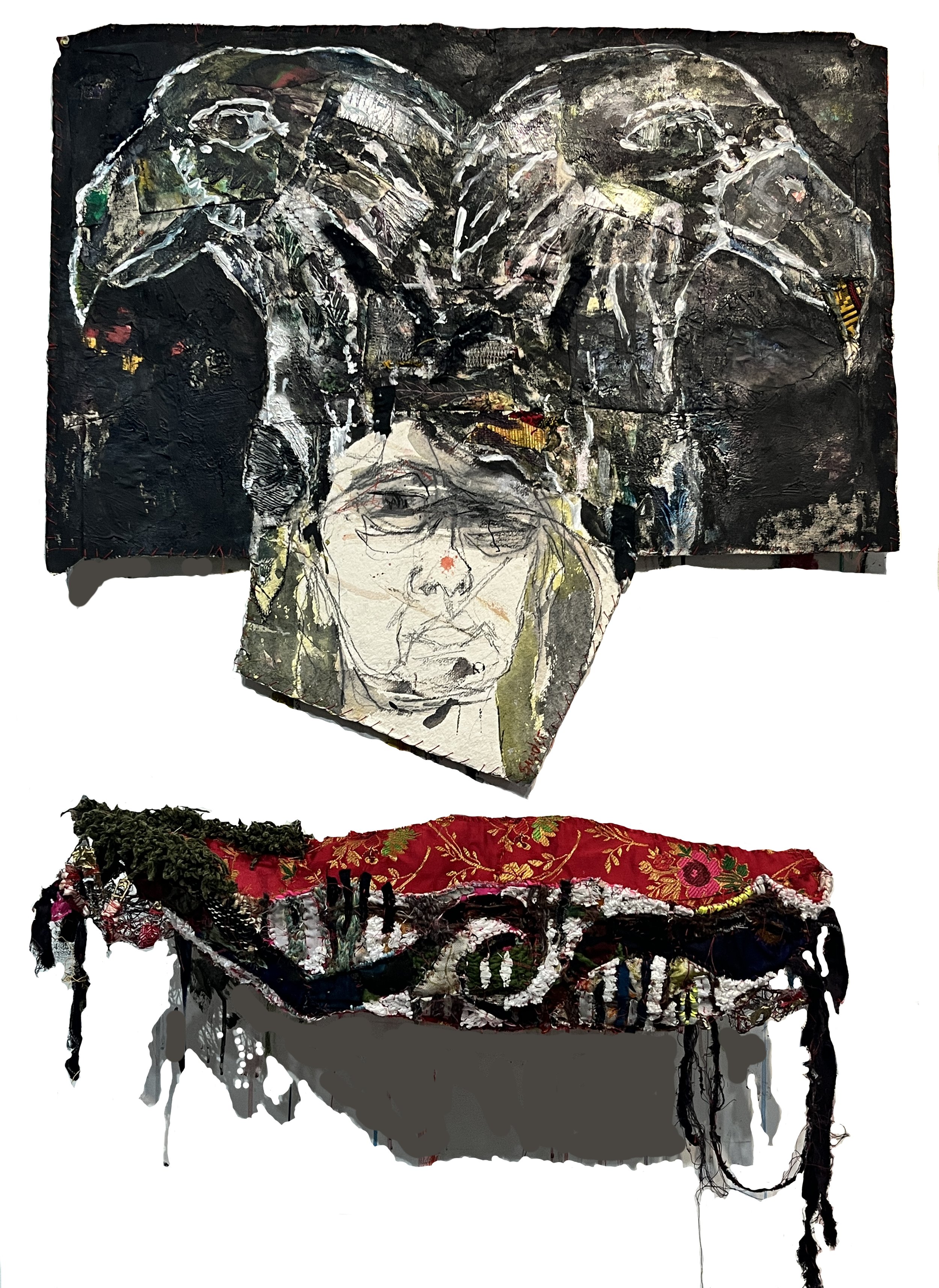
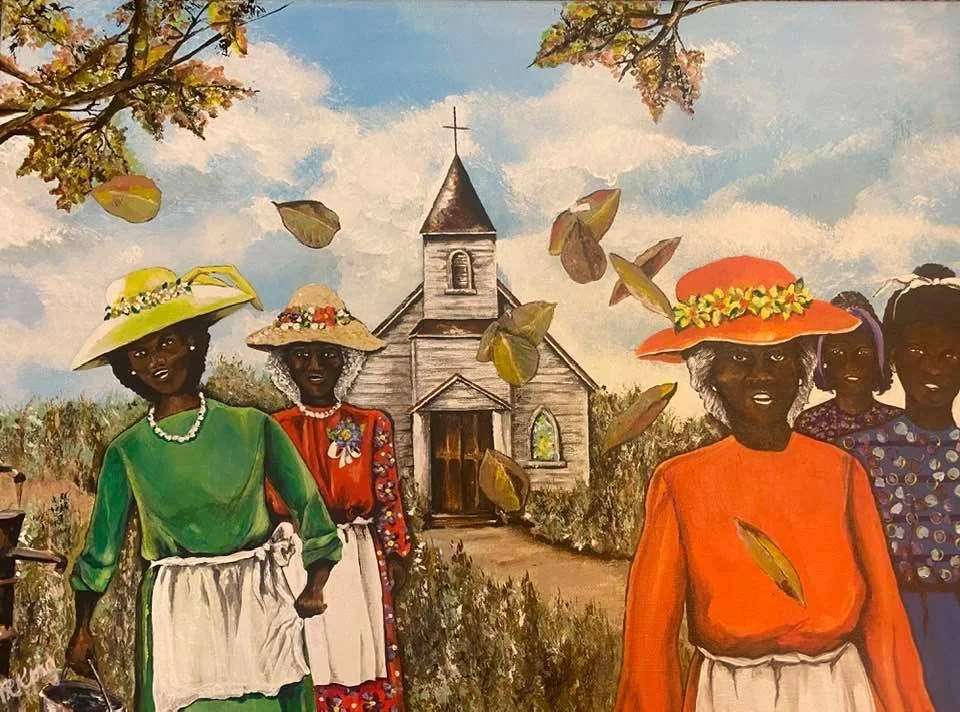
Artist- Sonya Diimmler

The Nook Gallery at The Koger Center for Arts

January - Najee Reese

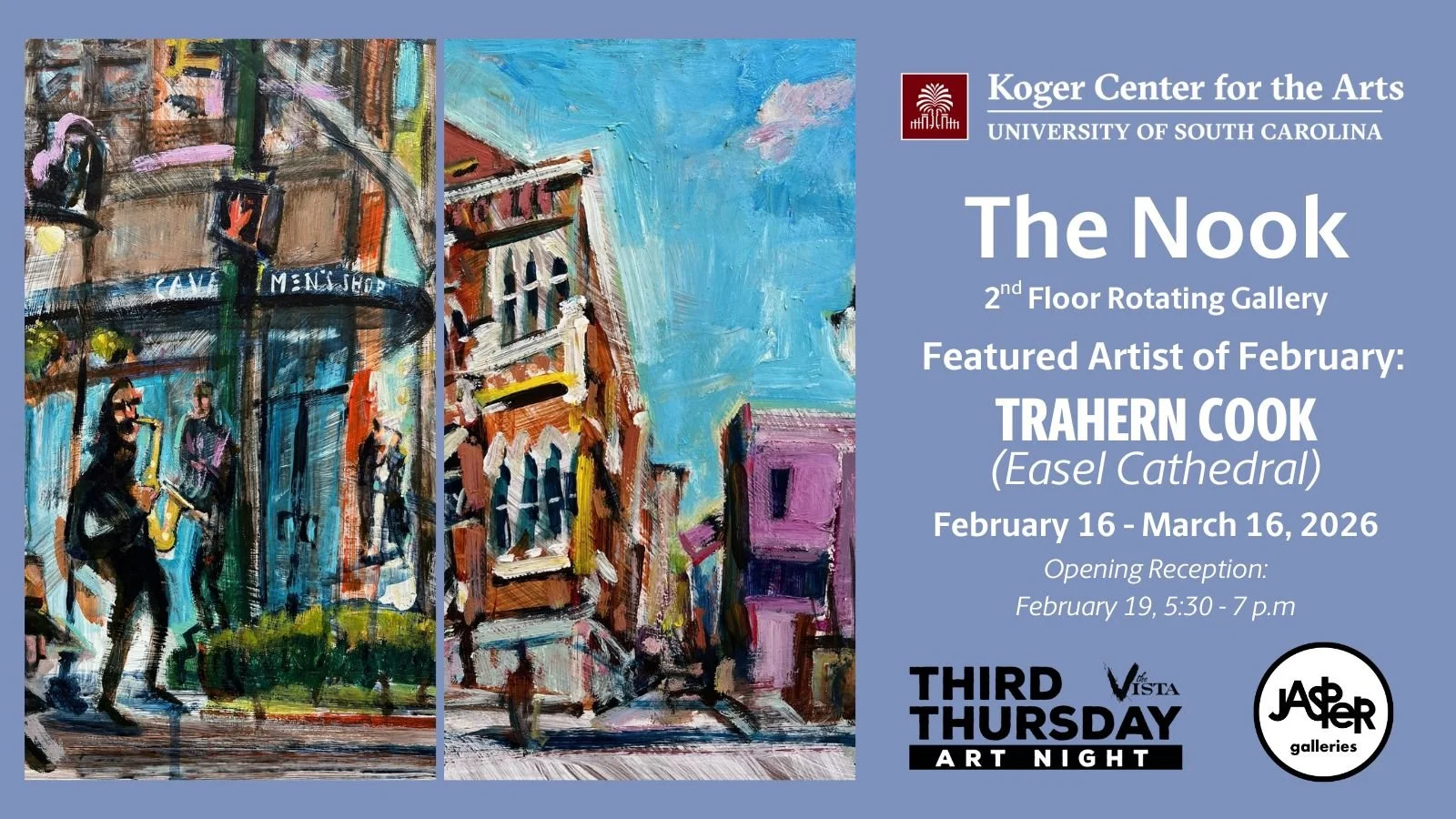
February - Easel Cathedral

March - Cait Maloney

April - Sarah Scruggs

May - Kathryn Morganelli

June - Ginny Merett

July - Sonya Diimmler

August - Isaac Udogwu

September - Patrick Parise

October - Keshoan Johnson

November thru December - K Wayne Thornley


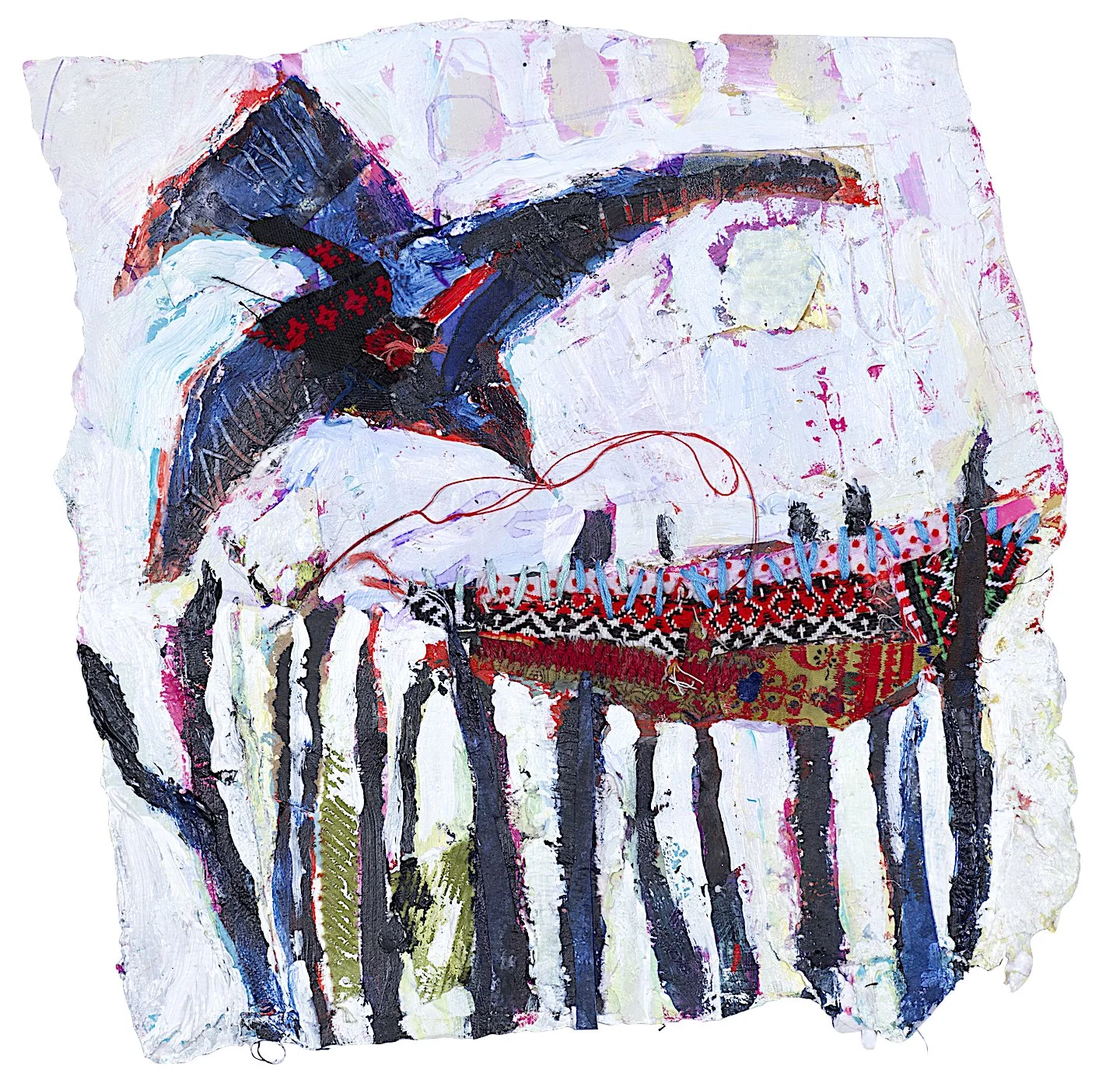
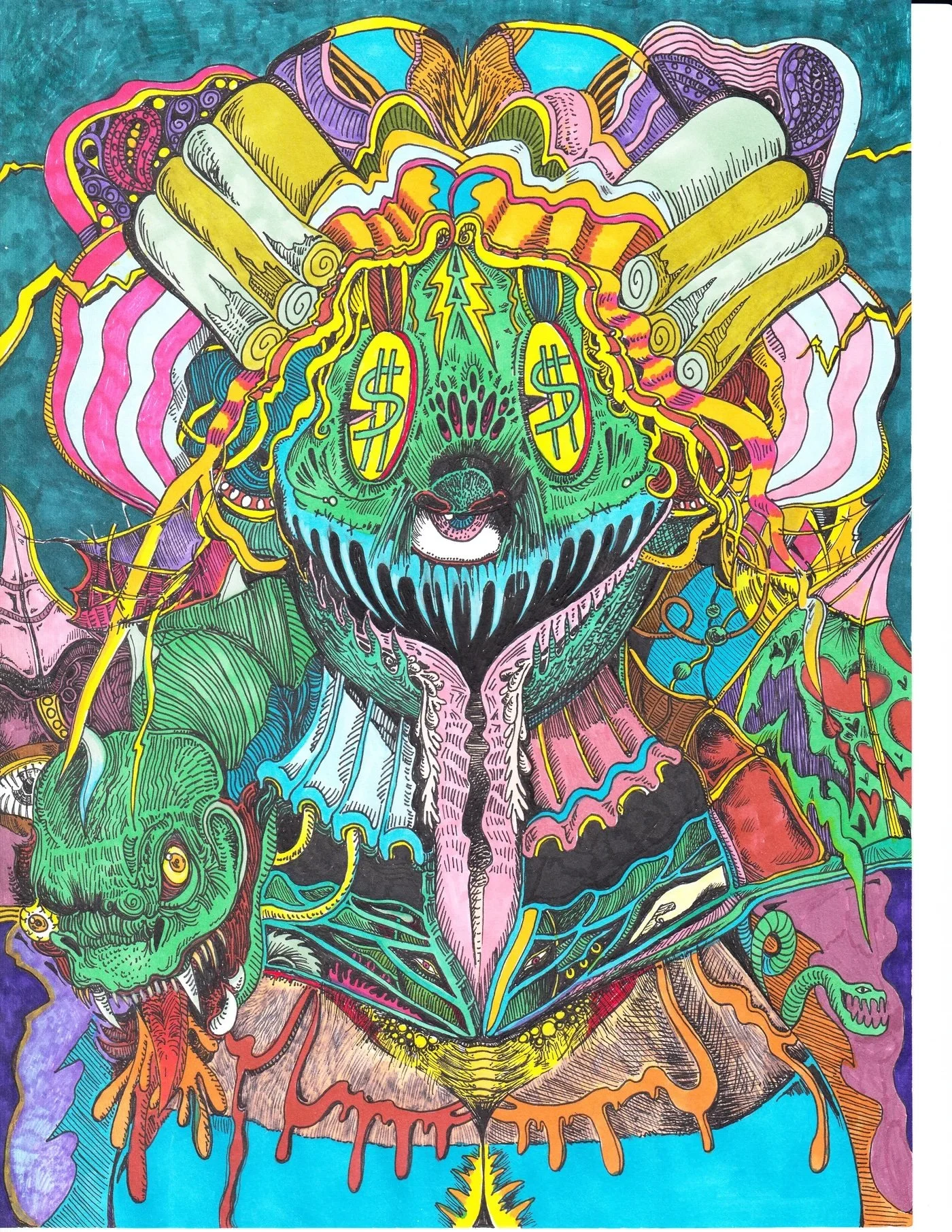
Artist - Harry McFadden

Motor Supply Co. Bistro

February - Harry McFadden

April - Thomas Crouch

July - Katie Chandler

October - Kelley Pettibone


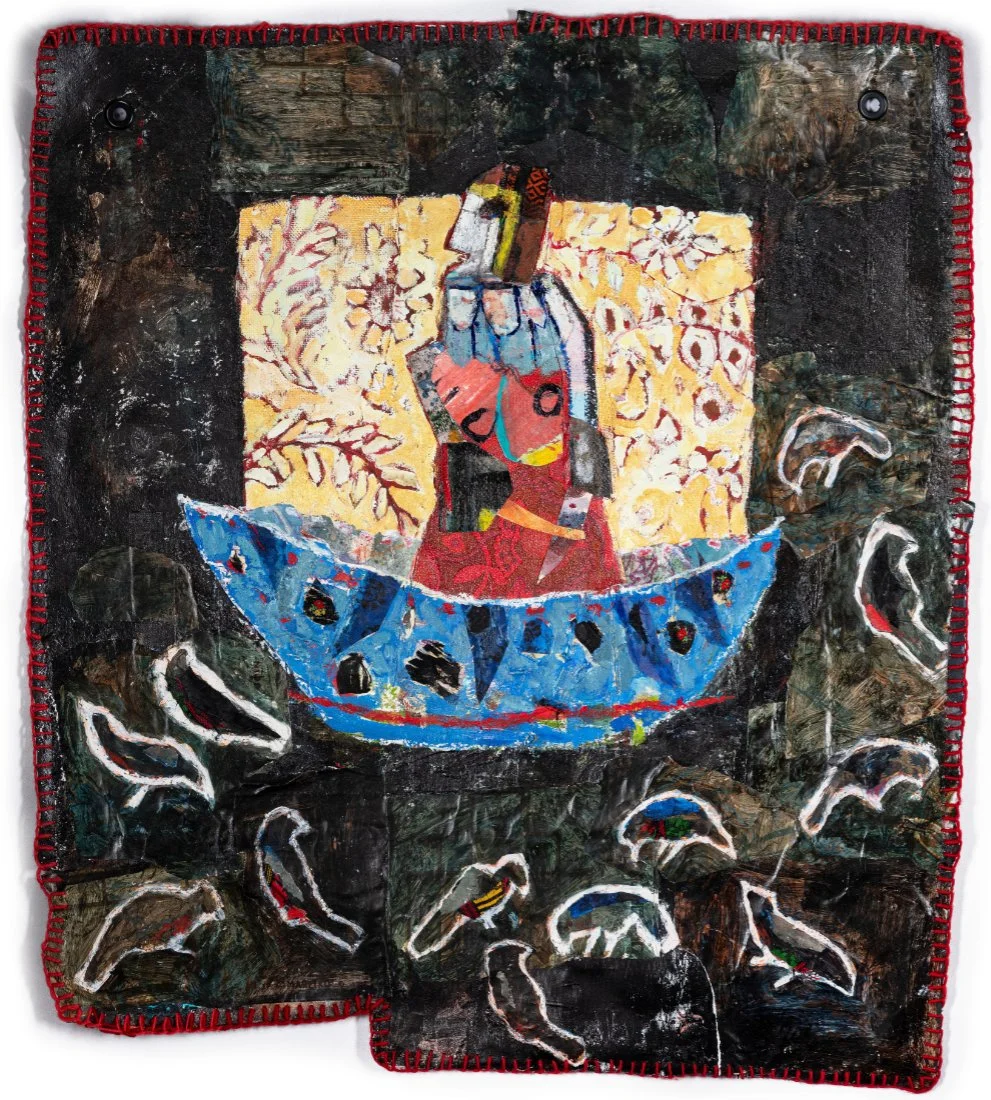
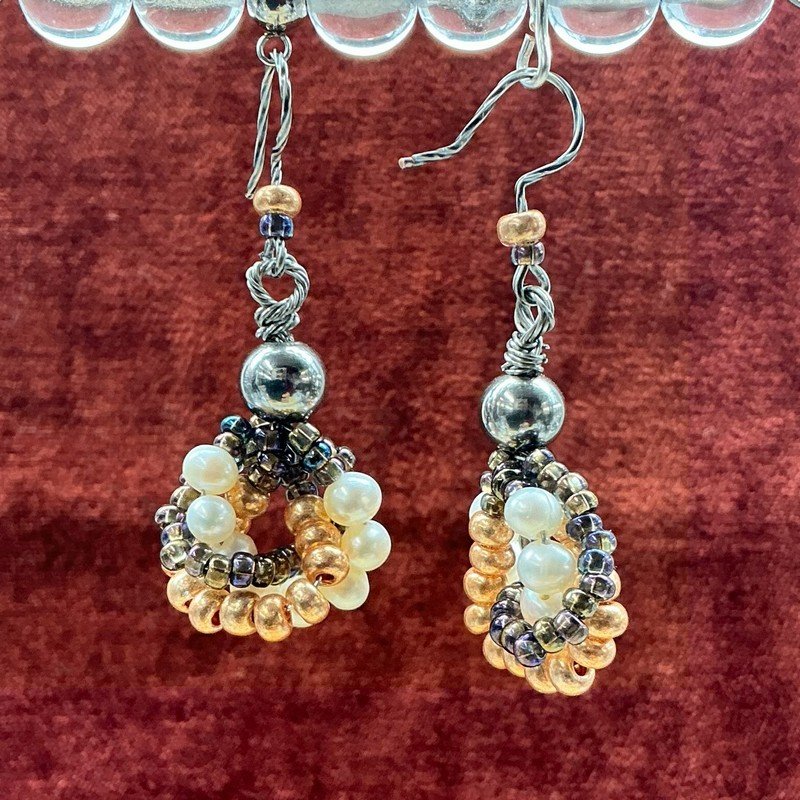
Artist - Clayton King

Jasper’s Tiny Gallery

January - Clayton King

February - Amy Kuenzie

March - Becci Robbins

April - Lucy Bailey

May - Tracey Seibert

June - Betsy Halford

July - Sarah Hilton

August -  Faith Mathis 

September - Jana Willis

October - Wendy Diaz (Inti Eclectic)

November - Megan Tapley 

December - TBD

Jasper’s Tiny Gallery, begun in 2019, is a virtual gallery open 24/7 where you can shop online at your convenience. Tiny Gallery art cannot be larger than 15” in any dimension and must be priced les than $250, with the majority of pieces in the less than $100 range. We developed Jasper’s Tiny Gallery as an entry level space for new collectors and working folks who want to build an art collection on an artist’s budget. By limiting the size of the art we are often able to program some of the area’s most high profile artists who create smaller, more affordable work specifically for this gallery.


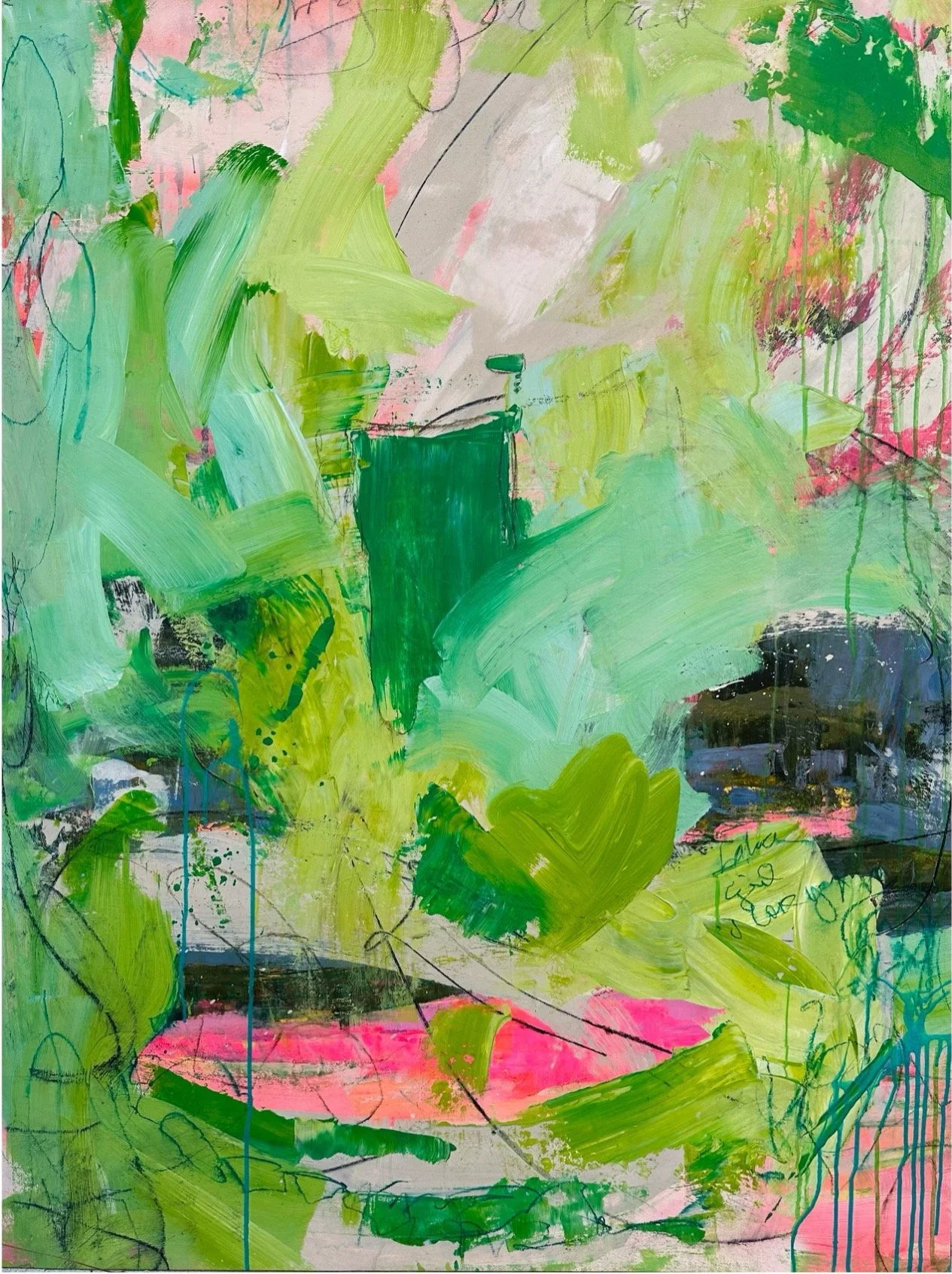
Artist - Wilma Ruth King

Harbison Theatre Gallery

Spring - Walker Canada

Fall - Wilma Ruth King


Artist - Lucas Sams

Sound Bites Eatery*

January - Anna Herrera

February - Anna Herrera

March - Lucas Sams*

April - Jessica Ream*

May - Barry White*

June - Michael Morris*

July - JJ Burton*

August - Terri Birthday Show

September - Jackie Bobo*

October - Bonita Strickland*

November - Cam Moore*

December - Emily Moffitt*

*Jasper was disappointed to learn that our gracious host at Sound Bites Eatery has made the difficult decision to close their doors effective February 6, 2026. We can’t thank Terri Mac and her team enough for making all of us at Jasper, and all the artists we represent, feel so at home (and well-fed!) since the very beginning. While we all mourn the loss of this home-base gathering space for artists and arts lovers, we are delighted to celebrate our final artist on the Jasper wall who, coincidentally, is Anna Herrera, the owner’s daughter and a fine artist! (Ironically, we had scheduled Anna’s exhibition as part of the 2026 lineup prior to hearing the news that she would be our final First Thursday artist at Sound Bites Eatery.

We are currently in search of other public walls on which we can show the fully-programmed 2026 roster of Sound Bites artists, so we are announcing that roster with our fingers crossed that the proprietors of a future space will make themselves known. We’d love to hear from you!

** The Jasper Gallery Sidewalk Gallery in the windows of the Meridian Building downtown is currently being developed. We look forward Making the announcement of our first artist roster very soon!


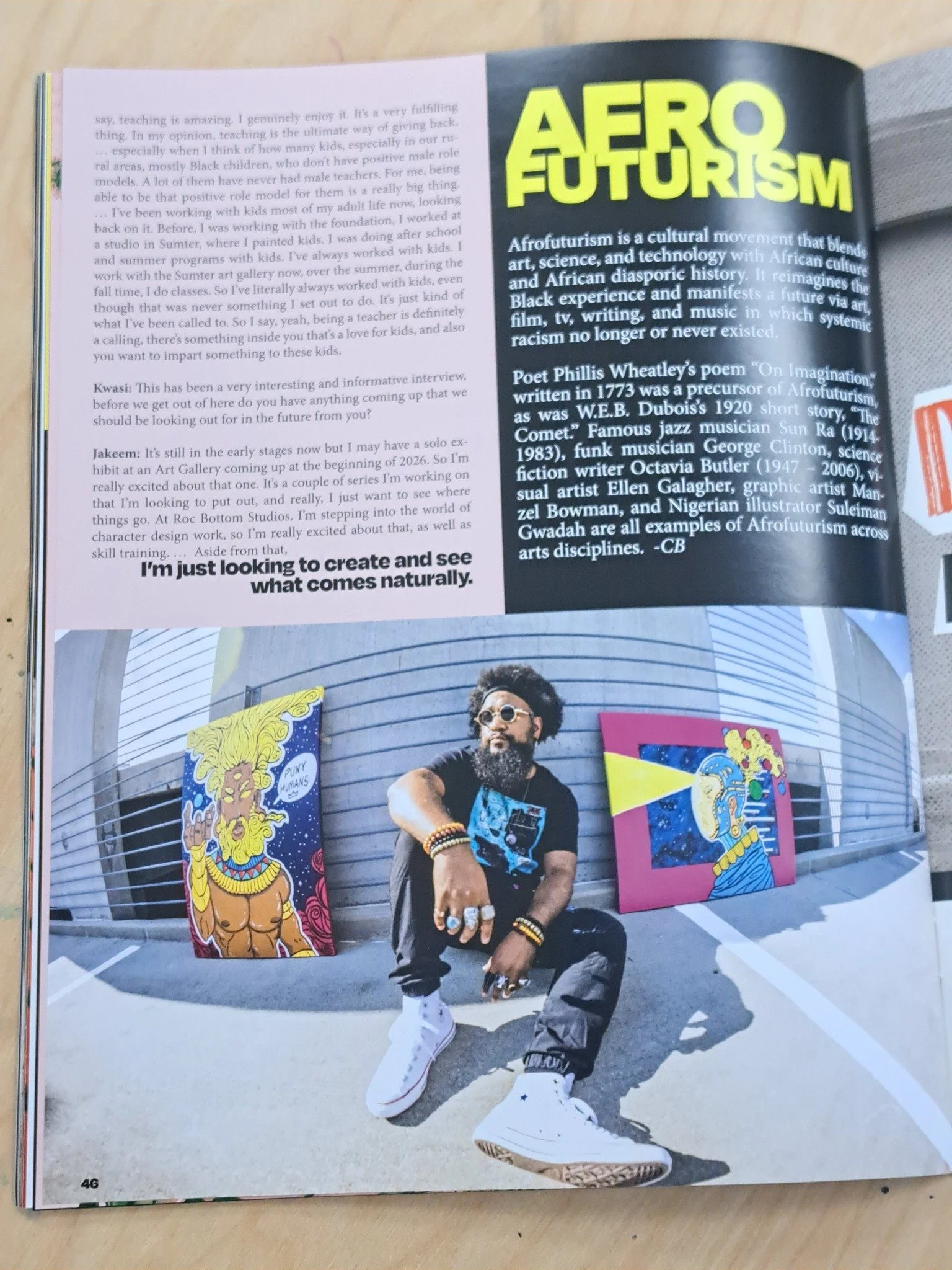
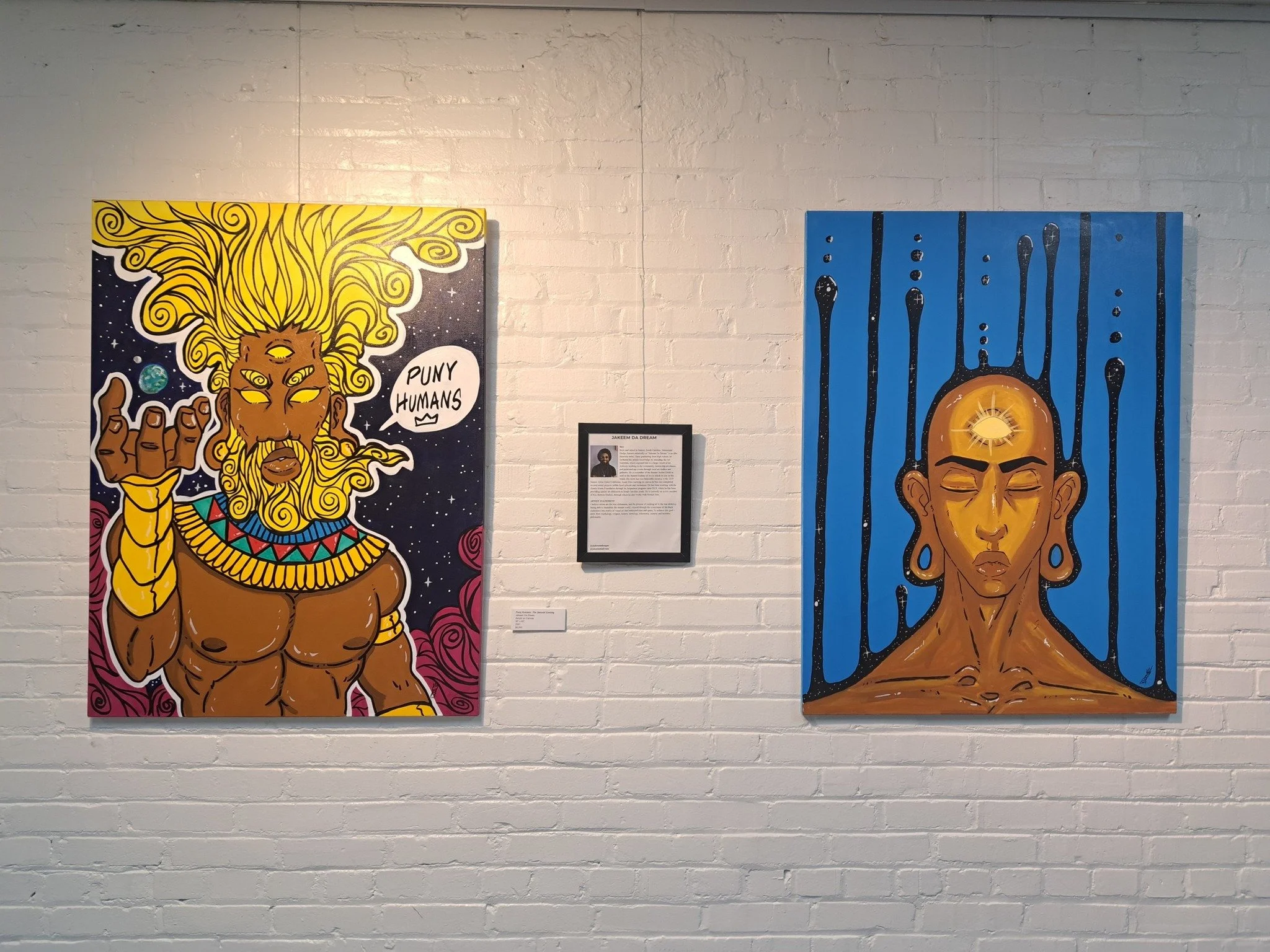
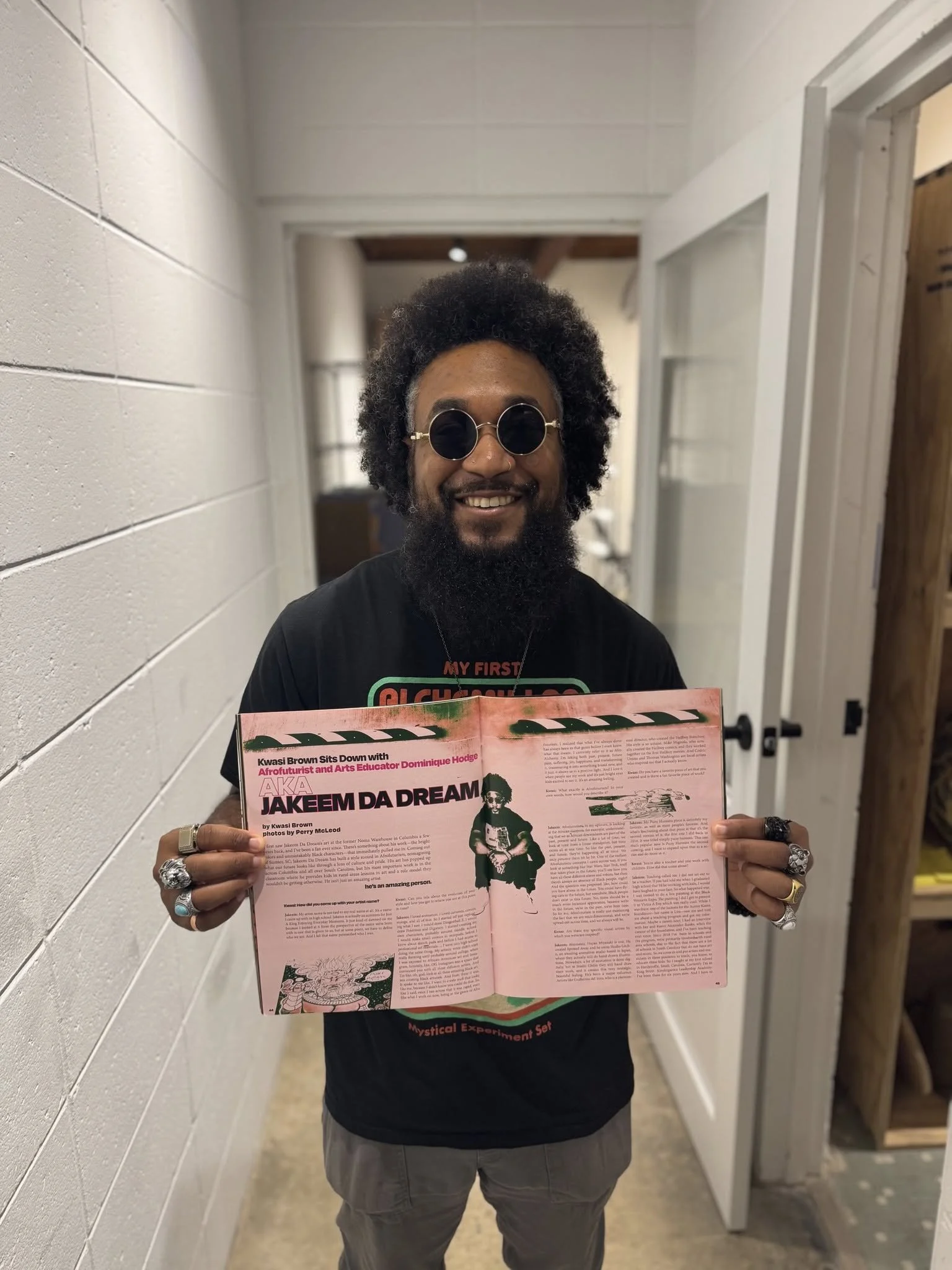
From the print issue: Kwasi Brown Sits Down with Afrofuturist and Arts Educator Dominique Hodge - AKA Jakeem Da Dream

I first saw Jakeem Da Dream’s art at the former Noma Warehouse in Columbia a few years back, and I’ve been a fan ever since. There’s something about his work—the bright colors and unmistakably Black characters—that immediately pulled me in. Coming out of Sumter, SC, Jakeem Da Dream has built a style rooted in Afrofuturism, reimagining what our future looks like through a lens of culture and pride. His art has popped up across Columbia and all over South Carolina, but his most important work is in the classroom where he provides kids in rural areas lessons in art and a role model they wouldn’t be getting otherwise. He isn’t just an amazing artist he’s an amazing person.

~~~~~

Kwasi: How did you come up with your artist name?

Jakeem: My artist name is not tied to my real name at all. It's a name I came up with in high school. Jakeem is actually an acronym for Just A King Enjoying Everyday Moments. It just kind of dawned on me because I looked at it from the perspective of the name we're born with is one that is given to us, but at some point, we have to define who we are. And I felt that name personified who I was.


Kwasi: Can you talk about the evolution of your style and how you got to where you are at this point in time?

Jakeem: I loved animation. I loved cartoons, comics, manga, and all of that. So I started off just replicating what I saw. I would draw Dragonball Z. I would draw Pokémon and Digimon. I started creating my own characters, probably around middle school. I would make small comics in notepads, before I knew about sketch pads and before I had access to professional art materials. ... I went into high school doing the same thing. My artistic voice didn't start really forming until probably around college, when I was exposed to African American art and Instagram, honestly, like, OG Instagram was a space that connected you with all these different artists. And I'm like, oh, god, look at all these amazing Black artists creating Black artwork. And from there it was, It spoke to me like, I want to create stuff that looks like me, because I didn't know you could do that. So, like I said, once I ran across that it was rapid, even like what I work on now, being in the genre of Afro futurism, I realized that what I've always done has always been in that genre before I even knew what that meant. I currently refer to it as Afro Alchemy. I'm taking both past, present, future pain, suffering, joy, happiness, and transforming it, transmuting it into something brand new, and it just, it shows us in a positive light. And I love it when people see my work and it’s just bright eyes kids excited to see it. It's an amazing feeling.

Kwasi: What exactly is Afrofuturism? In your own words, how would you describe it? 

Jakeem: Afrofuturism, in my opinion, is looking at the African diaspora, for example, understanding that we as African descendants are part of the past, present and future. Like a lot of time, we look at time from a linear standpoint, but time exists all at one time. So like the past, present, and future, they're happening all at once. We only perceive them bit by bit. One of the earliest Afrofuturistic concepts I came across was, if you look at something like Star Wars, Star Trek, stuff that takes place in the future, you'll see how you have all these different aliens and robots, but then there's always an absence of Black people, right? And the question was proposed, like, how could you have aliens in the future. You could have flying cars in the future, but somehow, Black people don't exist in this future. No, there should be a much more balanced appearance, because we're in the future, we're in the past, we're here now. So for me, Afrofuturism is really just examining the fact that we are multidimensional, and we're spread out across time, and we always will be.


Kwasi: Are there any specific visual artists by which you were/are inspired? 

Jakeem: Absolutely, Hayao Miyazaki is one. He created Spirited Away and he owns Studio Ghibli, an amazing animation studio based in Japan, where they actually still do hand drawn illustrations. Nowadays, a lot of animation is done digitally, but at Studio Ghibli they still hand draw their work, and it creates this very nostalgic, beautiful feeling. He's been a major influence. Artists like Guillermo del Toro, who is a phenomenal director, who created the Hellboy franchise. His style is so unique. Mike Mignola, who actually created the Hellboy comics, and they worked together on the first Hellboy movies. And Cedric Umoja and Thomas Washington are local artists who inspired me that I actually know.


Kwasi: Do you have a favorite piece of art that you created and is there a fan favorite piece of work? 

Jakeem: My Puny Humans piece is definitely my favorite, as well as most people's favorite. And what's fascinating about that piece is that it’s the second version of it, the first one I did back in 2016. It was titled simply puny humans. This one that's popular now is Puny Humans the second coming, and I want to expand upon that as a series and do more in it.  

Kwasi: You're also a teacher and you work with children. How did that come about?  

Jakeem: Teaching called me. I did not set out to be a teacher. If you had told me when I graduated high school that I'd be working with kids, I would have laughed in your face. So what happened was, I was invited to do a live painting at the Black Women’s Expo. The painting I did I got to present it to Vivica A Fox which was really cool. While I was there, one of the liaisons for the Auntie Karen foundation--her name is Lisa—saw me and told me about a teaching program and got my information. Maybe a month later, I had an interview with her and Karen Alexander Banks, who's the creator of the foundation, and I've been teaching ever since. Since 2018 I've  been in schools and the program, we're primarily involved with rural area schools, due to the fact that there are a lot of schools in South Carolina that do not have art and music. So we come in and put artists and musicians in these positions to teach, you know, to educate these kids. So I taught at my first school in Hardeeville, South Carolina. Currently I'm in King Street  Kindergarten Leadership Academy. I've been there for six years now. And I have to say, teaching is amazing. I genuinely enjoy it. It's a very fulfilling thing. In my opinion, teaching is the ultimate way of giving back, … especially when I think of how many kids, especially in our rural areas, mostly Black children, who don't have positive male role models. A lot of them have never had male teachers. For me, being able to be that positive role model for them is a really big thing. … I've been working with kids most of my adult life now, looking back on it. Before, I was working with the foundation, I worked at a studio in Sumter, where I painted kids. I was doing after school and summer programs with kids. I've always worked with kids. I work with the Sumter art gallery now, over the summer, during the fall time, I do classes. So I've literally always worked with kids, even though that was never something I set out to do. It's just kind of what I've been called to. So I say, yeah, being a teacher is definitely a calling, there's something inside you that's a love for kids, and also you want to impart something to these kids. 


Kwasi: This has been a very interesting and informative interview, before we get out of here do you have anything coming up that we should be looking out for in the future from you? 

Jakeem: It’s still in the early stages now but I may have a solo exhibit at an Art Gallery coming up at the beginning of 2026. So I'm really excited about that one. It's a couple of series I'm working on that I'm looking to put out, and really, I just want to see where things go. At Roc Bottom Studios. I'm stepping into the world of character design work, so I'm really excited about that, as well as skill training. …  Aside from that, I'm just looking to create and see what comes naturally.

Afrofuturism is a cultural movement that blends art, science, and technology with African culture and African diasporic history. It reimagines the Black experience and manifests a future via art, film, tv, writing, and music in which systemic racism no longer or never existed.


Poet Phillis Wheatley’s poem “On Imagination,” written in 1773 was a precursor of Afrofuturism, as was W.E.B. Dubois’s 1920 short story, “The Comet.” Famous jazz musician Sun Ra (1914-1983), funk musician George Clinton, science fiction writer Octavia Butler (1947 – 2006), visual artist Ellen Galagher, graphic artist Manzel Bowman, and Nigerian illustrator Suleiman Gwadah are all examples of Afrofuturism across arts disciplines. 


From the print issue: The Runout – Creating Music and Community In Different Ways By Kevin Oliver

There’s a moment on the new album from The Runout, Just As Real, that may sum up the past four years of the band’s existence. On “Light a Fire,” Jeff Gregory sings, “Do you think we could light a fire and stand around until we feel better? I’ll leave it to you now.” They lit a fire back in 2021 with their last full-length record, With Your Eyes Closed, and while they haven’t exactly been standing around, the band has spent the better part of the interim exploring what it means to make music together, and separately, and where they fit in the context of the greater community. 

“There was writing all along, and intention,” says Gregory, the band’s principal songwriter, singer, and guitarist. “The whole while, I was making music, and getting pissed off about making music, like we all do. There were some of these songs that we played live for a couple of years or more, too. And then it got to a point where it was just that we needed to record, that I was dragging my heels, it felt like.” 

Outside of some infrequent singles put online, the first project to see release over the summer was Hidden Variable, a short EP of songs featuring the acoustic duo version of the group, just Gregory and his wife Kelley B. Gregory, who provides crucial, sound-defining harmony vocals. Her presence softens Jeff’s sometimes stark, percussive style in ways that are hard to describe without hearing them together, as the voices intertwine in ways that only true intimacy and connection can muster. The duo arrangements really bring out the pair’s influences, with “When” evoking classic Simon and Garfunkel harmonies, and “The Millstone” possessing the plainspoken profundity of Dawes. It’s also an indicator of the upward progression of Gregory’s songwriting, which stands tall even in the unflinchingly exposed acoustic format. Take these opening lines from “The Millstone”: 

i'm grateful for the grain

even Tuesday mornings never felt the same without the pain

i can picture raindrops falling on the blades of green

now the oats roll in my hands above this screen

like we rolled out in the fields in younger days

 In one verse he’s expressed gratitude, a work ethic, and nostalgia for a more innocent time; the song goes on to describe, in the words of the introduction on the album’s Bandcamp page, “that blue collar urge to just survive and be a fucking good person in the modern era of perverse capitalism.” It’s a delicate balancing act, but one that Gregory has seemingly mastered. 

Working this time around with producer and fellow musician Todd Mathis on the full band recordings, the parts were done in some different ways, Gregory says.

“My guitar parts and Kelley’s vocals were done in our kitchen on both the duo EP and the full band songs,” He says. “The EP was put out as-is, just us. For the band songs we shipped everything over to Todd, who put all the pieces together in his studio.” 

Perhaps the biggest change in the way things were being done in recent years was the addition of the Runout Duo, putting Jeff and Kelley in places the band had never gone, and exposing them, their sound, and their original music to more and more audiences. 

“The organic thing that has happened really slowly, but really surely with this is that we’re seeing people who are coming to a duo show at Columbia Craft, for example, and the next full band show they’re also showing up to see us as a full band.” The two feed off each other, in Gregory’s opinion.  

“When we started doing the duo three years ago, I cut back to a two day a week job, from full time, so we could schedule more shows,” He says. “I’ve worried less about having a digital presence, playing the algorithm game, and building a huge social media crowd, and leaned more into the shows, the live music side of things.” 

Gregory feels it has paid off in a more connected, loyal audience. “I’m finding that people are showing up, buying the shirts, wanting to have a physical CD or to be able to listen to the songs they hear us play,” He says. “It’s not hundreds of people–but it’s 45, or 50 people, that keep showing up.” 

Those duo show experiences, playing covers for the bar and restaurant crowds alongside the original music, have fed the band as well. With Moses Andrews on bass, Mike Scarboro on drums, and Chris Compton on lead guitar, those other band members have been active outside of the Runout as well, with Andrews in particular releasing solo albums and playing in Patrick Davis’s Midnight Choir band, Scarboro playing drums with a host of others, and Compton has a long discography of his own excellent songwriting and music. 

“We’re all creative individuals,” Andrews says. “You bring all those other experiences back here and now you’re at rehearsal jamming on a cover that Jeff and Kelley have been doing as a duo and ‘Hey let’s see what it sounds like with the whole band,’ and that grows the sound of the band that way. It’s also a function of how the music community in Columbia makes it easy, whether it’s professionally branching out, or just creative opportunities.” 

“We try to have the culture of a family,” Scarboro says. “We like to set up practices with food, have a hangout session, and then maybe try to play some music. When you know each other so well, know each other’s personalities, you’re more comfortable delivering a new line, or an opinion or a thought on a song–So everybody feels like they can toss something out and see what Jeff says, and he’s really good about leaving a lot of openness for us to just kind of do our thing.” 

Those close personal connections and years of playing both together and apart lend the band’s songs an easygoing familiarity, even if they’re new like the latest release. “Me and the Lord” is a great example, and one of the most fully fleshed out arrangements featuring the whole band. Over a rollicking organ and piano accented tune that’s straight out of the Leon Russell school of 1970s ensemble rock, Gregory declaims a non-materialistic way of living life and practicing one’s spiritual faith.


 “and I ain't got money much

it gets between me and the lord

that may sound funny but

there ain't that much I can't afford”


“There seems to be a way that we do things, and I don’t know what culture this comes from–is it church culture? Nashville culture? In terms of music with formal stuff like lead sheets,” Gregory says. “Sometimes it just happens, sometimes songs are more format based and we can work them out like that.”   

Then there are the ones that are more difficult, requiring more work. “Sometimes songs take a long time; ‘Currency’ was one that I wrote three times thinking that the guitar lick was going to be for something else,” Gregory says. “Then finally some other words felt better with it, and it settled, and never turned into anything else–and that was over the course of years. But then, some songs I write in five minutes.”  

One result of the recent recording sessions is that they have found some things that really work well for them, Gregory says. “We realized that we really enjoy recording our vocals live, around one microphone, to get the harmony,” he says. “Because our harmonies lock differently in the timing if we try to record separately and then blend it in later. So it has just been moving us forward, on all sides.” 

There’s even more movement in the works, Gregory says, with more releases planned out.

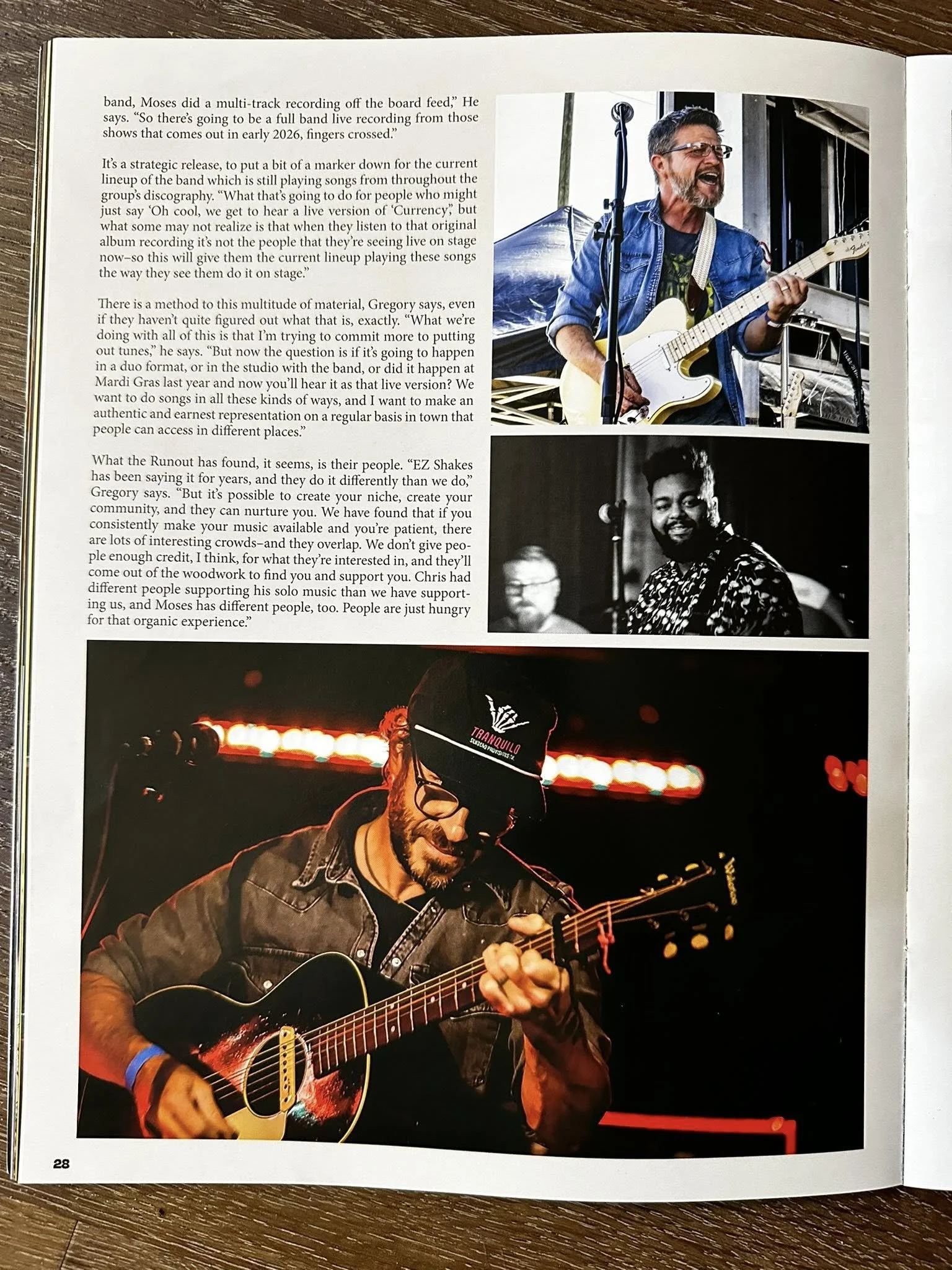
“All of the live shows that we did this past spring that were full band, Moses did a multi-track recording off the board feed,” He says. “So there’s going to be a full band live recording from those shows that comes out in early 2026, fingers crossed.”


It’s a strategic release, to put a bit of a marker down for the current lineup of the band which is still playing songs from throughout the group’s discography. “What that’s going to do for people who might just say ‘Oh cool, we get to hear a live version of ‘Currency’,’ but what some may not realize is that when they listen to that original album recording it’s not the people that they’re seeing live on stage now–so this will give them the current lineup playing these songs the way they see them do it on stage.” 

There is a method to this multitude of material, Gregory says, even if they haven’t quite figured out what that is, exactly. “What we’re doing with all of this is that I’m trying to commit more to putting out tunes,” he says. “But now the question is if it’s going to happen in a duo format, or in the studio with the band, or did it happen at Mardi Gras last year and now you’ll hear it as that live version? We want to do songs in all these kinds of ways, and I want to make an authentic and earnest representation on a regular basis in town that people can access in different places.”

 What the Runout has found, it seems, is their people. “EZ Shakes has been saying it for years, and they do it differently than we do,” Gregory says. “But it’s possible to create your niche, create your community, and they can nurture you. We have found that if you consistently make your music available and you’re patient, there are lots of interesting crowds–and they overlap. We don’t give people enough credit, I think, for what they’re interested in, and they’ll come out of the woodwork to find you and support you. Chris had different people supporting his solo music than we have supporting us, and Moses has different people, too. People are just hungry for that organic experience.” 

Jasper Magazine photos by Perry McLeod

Don’t miss your next chance to see, hear, & enjoy

The Runout

Dec 20th at Greener Pastures Brewing 6-9p

Camden, SC


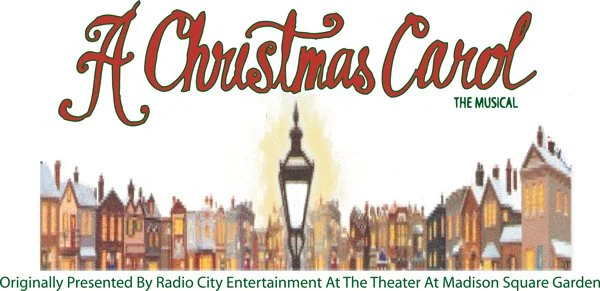
REVIEW: Town Theatre’s A CHRISTMAS CAROL: THE MUSICAL Shines! By Jane Turner Peterson


Don’t wait another minute—head to Town Theatre’s website or pick up the phone now! Tickets will go fast for this dazzling production of Charles Dickens’ A Christmas Carol the Musical, and you do NOT want to miss it. This spectacular musical, directed by veteran Jerry Crouch, is guaranteed to fill you with holiday cheer from the moment the curtain rises. With masterful choreography by Christy Shealy Mills and gorgeous vocals shaped by music director Kathy Seppamaki, this show is easily one of the standouts of 2025. 

Featuring music by Alan Menken, lyrics by Lynn Ahrens, and a book by Mike Ockrent and Ahrens, this adaptation remains one of the most beloved versions of Dickens’ classic—and Town Theatre’s massive, talented cast brings every note and moment to life with heart and precision. 

We follow Ebenezer Scrooge on his iconic Christmas Eve journey as the Ghosts of Christmas Past, Present, and Future visit him. Each encounter is beautifully realized, reminding us all of the timeless power of reflection, redemption, and the true meaning of Christmas. 

With a cast of more than 50 adult, teen, and child performers, this production is nothing short of impressive. Crouch’s direction is seamless, moving the company through polished scenes and picture-perfect vignettes. The multi-level set is both stunning and functional, transitions are smooth and choreographed, and the use of the trapdoor (a fan favorite!) adds a delightful theatrical flair. The period costumes are exquisite, adding authenticity and charm to every scene. 

The dance numbers alone are worth the price of admission. “Link by Link” and “Dancing on Your Grave” light up the stage with thrilling choreography and ensemble work, while “Mr. Fezziwig’s Annual Christmas Ball” bursts with joy and energy. Christy Shealy Mills—with some help from her daughter Zanna Mills—delivers showstopping choreography that elevates these big dance moments into true highlights of the night. 

Tracy Steele delivers a brilliant performance as Ebenezer Scrooge, effortlessly capturing every comedic beat and emotional turn. His vocals shine, his presence commands the stage, and his transformation is deeply satisfying to watch. Additional standout performances include Jerimy Woodall as Marley, Zanna Mills as the luminous Ghost of Christmas Past, Gavin Slaughter as the exuberant Ghost of Christmas Present, and Ashton Boland as the chilling Ghost of Christmas Future. And don’t miss Gina Saviola’s delightful moments as Mrs. Mops! 

This is the holiday production to see this season. A Christmas Carol runs December 5–21. Tickets are available by phone at 803.799.2510, online at towntheatre.com, or in person at the theatre from noon to 5 p.m., Tuesday–Friday, at 1012 Sumter Street in downtown Columbia. 

Make it part of your family’s holiday tradition—get your tickets today!

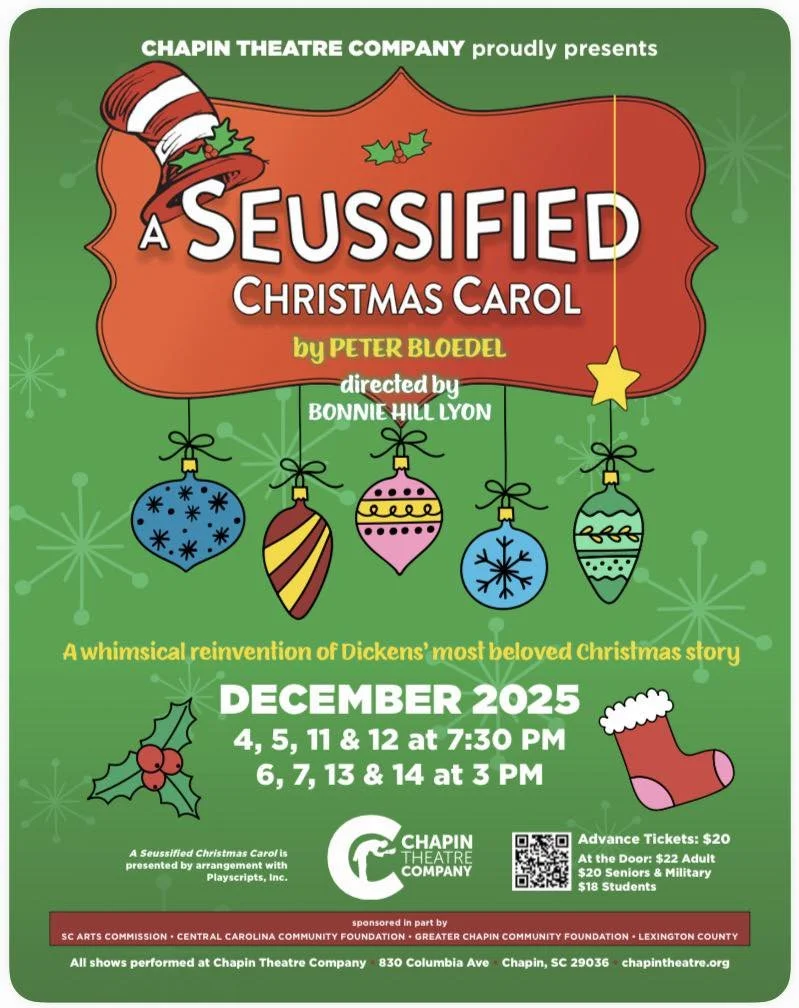
REVIEW: Chapin Theatre’s A Seussified Christmas Carol Sells Out Before Opening!** by Jane Peterson

One thing I always hope to do as a reviewer is to help boost ticket sales for local productions. Community theatres rely on us to keep their mission of bringing quality theatre alive. In this case, though, it is a true “snooze, you lose” situation—A Seussified Christmas Carol by Peter Bloedel sold out before opening night. It’s a shame Chapin Theatre isn’t extending the run for one more weekend, because this delightful production deserves to be seen by even more people. Drawing from the genius of two of my favorite authors—Charles Dickens and Dr. Seuss—this show blends the best of both worlds to retell the story of Ebenezer Scrooge and his transformation, complete with Marley’s ghost and the ghosts of Christmas Past, Present, and Future.


Before I go on, here’s a tip: jump on Chapin’s 2026 fall membership deal! It’ll save you some money and guarantee your seat for next season. You can find all the details at chapintheatre.org.


A Seussified Christmas Carol follows Scrooge—the meanest, stingiest man in town—as he discovers his heart and soul through encounters with the spirits. He’s forced to face his selfish ways and ultimately embraces love, family, and the true spirit of Christmas. All of this is told through the wacky rhyming couplets of Dr. Seuss, making for a charming and whimsical experience. A stage full of young actors, mixed with seasoned performers of all ages, worked together wonderfully to bring this magical story to life. I smiled from start to finish.


Directed by Bonnie Hill Lyon, the large cast is expertly anchored by Gerald McWilliams as Scrooge, whose facial expressions and comic timing fit this miserly character perfectly. And yes—it’s “The Scrooge,” as he was once a rock star in his youth! Narrators 1 and 2 (think Thing 1 and Thing 2), played by Leah Gilbert and Emma Lyon, brought terrific energy and agility to their roles, guiding us through the story. Lonnie Owen—who must be nearly seven feet tall—was a fantastic contrast as Scrooge’s determined nephew, Beadheaded Fred. His booming presence and the chorus of children mimicking his laugh made him a standout Seuss-inspired character. Other notable performances include Scott Anderson as poor, anxious Bob Crachett, father of Timmy Lou Hoo, and Abby Mathias, who showed wonderful comedic range as both the Ghost of Christmas Past and Mrs. Cratchet.


The minimal cubic set and props by Sandy Steffan, along with costumes designed by Abby Mathias, were a perfect fit for this playful production. Chapin also made excellent use of their projection system thanks to the smart design work of Chris Harre. Choreographer Meredith Boehme kept the large cast moving smoothly and magically through the intimate space.


This talented ensemble also includes Luke Anderson, Christian Banks, Meredith Boehme, Rilyn Boehme, Gigi Cunningham, Lauren Dawkins, Nathan Dawson, Perry Dawson, Caroline Futch, Leah Gilbert, Lindsey Kelso, Nicole Kingsley, Len Lesslie, Gabriel Lyon, Faith Magann, Garrett Martin, Leo Owings, Audrey Roberts, Charleston Stalker, and Beaux Tyler.


Chapin Theatre’s 2026 season will feature:


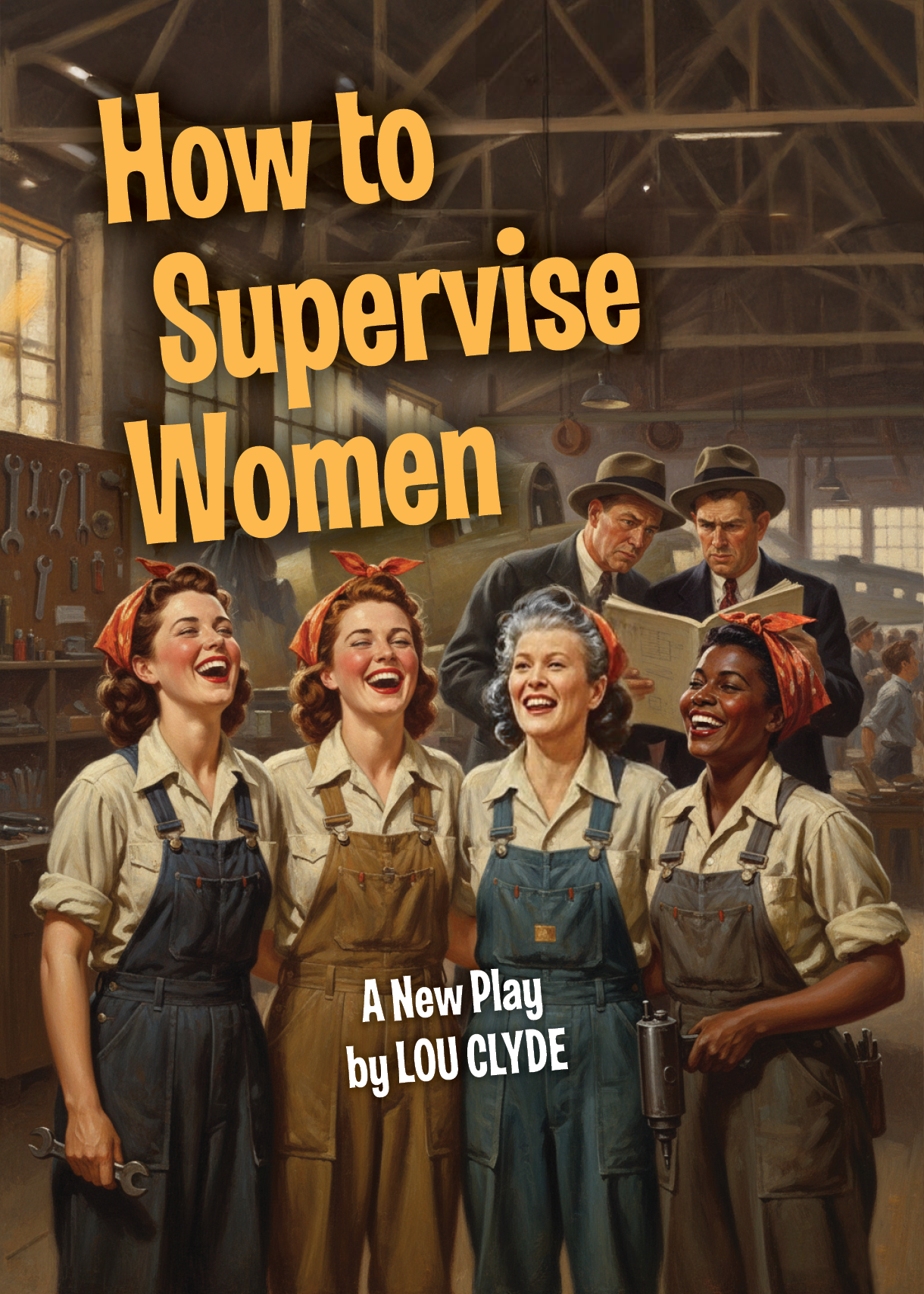
How to Supervise Women by Lou Clyde — Feb. 6–22

Nana’s Naughty Knickers by Katherine DiSavino — May 14–31

Mary Poppins by Julian Fellowes — July 16–26 (Harbison Theatre)

Holmes and Watson by Jerry Hatcher— Sept. 25–Oct. 11

Holiday Show — Dec. 3–13


For memberships or individual tickets, visit chapintheatre.org.

From the print issue: Becci Robbins Writes About Her Long-Time Passion Project - G.R.O.W. - reposted from Jasper Magazine

Becci Robbins

She sits at the corner of Elmwood and Marion, low-slung and unassuming, a stone’s throw from the red dome marking the old lunatic asylum on Bull Street (not to be confused with the other domed asylum, on Gervais). Unless you’re looking for her, she’s easy to miss. The hand-painted sign out front is dimly lit and reads simply GROW — Grass Roots Organizing Workshop.

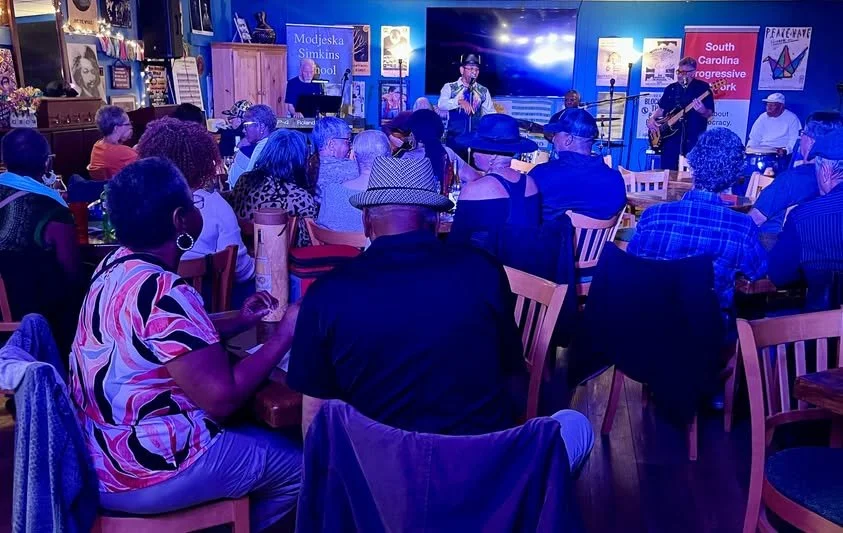
It’s Thursday evening, and traffic is thinning on Elmwood Avenue. The setting sun is reflected in the building’s front window, streaking it copper and gold. The door is propped open, letting in a blessed breeze and a slow trickle of musicians setting up for the night’s show. 

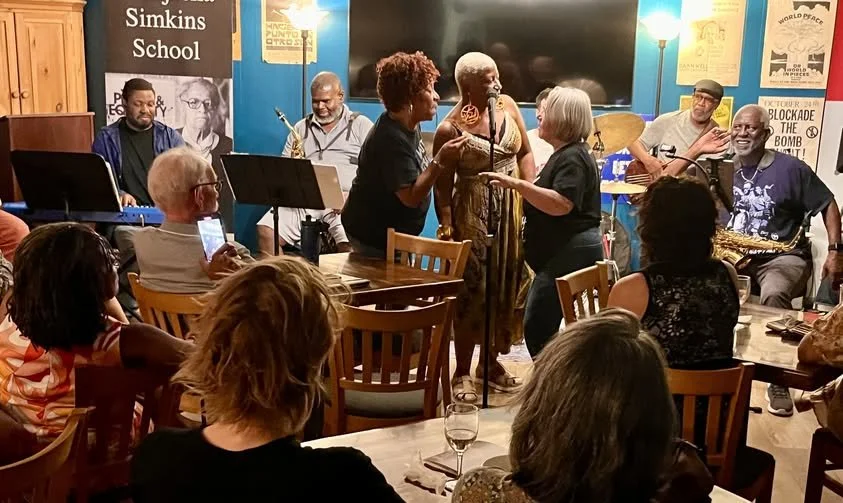
Chris trundles in with his upright, fires up the sound system, adjusts mics, turns on some background music, classic jazz. Antron and Ken come in, carrying music stands and their saxophones, followed by Dionne, who sets up her keyboard under the unblinking gaze of a pensive MLK. Joe makes several trips to his car to set up his drum kit. Geoff unpacks his guitar and settles onto a stool in the corner. Seitu makes the rounds, dispensing hugs, and pleasantries. Sara wanders in with a bag of tangerines and fresh outrage about the day’s news. 

My husband, Brett Bursey, stocks the bar and preps the cash drawer. I rearrange the tables that were moved when the peace group met here two days ago, and plug in the sound-activated disco lights. I set out fresh water and ice. Wash grapes, slice pound cake, arrange cookies on a platter. 

I never tire of the ritual, or the people. By now, they feel like family, and this corner of Columbia feels like home. For three years, we have gathered here twice a month for jazz workshops. In August, we added blues to the menu, so we now offer live music every Thursday night. It is a joyful noise — loud enough to mute, if only for a few hours, the freak show raging outside. 

The free jam sessions have cultivated a loyal following, with seasoned professionals sharing the stage with young talent. There is a generosity of spirit on stage and in the audience that favors participation over flawless performance. Because you never know who is going to show up, the shows are always fresh. Sometimes, they are pure magic.

A friend calls it therapy. She is not alone. So many of us are craving connection in these socially fractured and politically dangerous times. Gathering like this feels like resistance. 

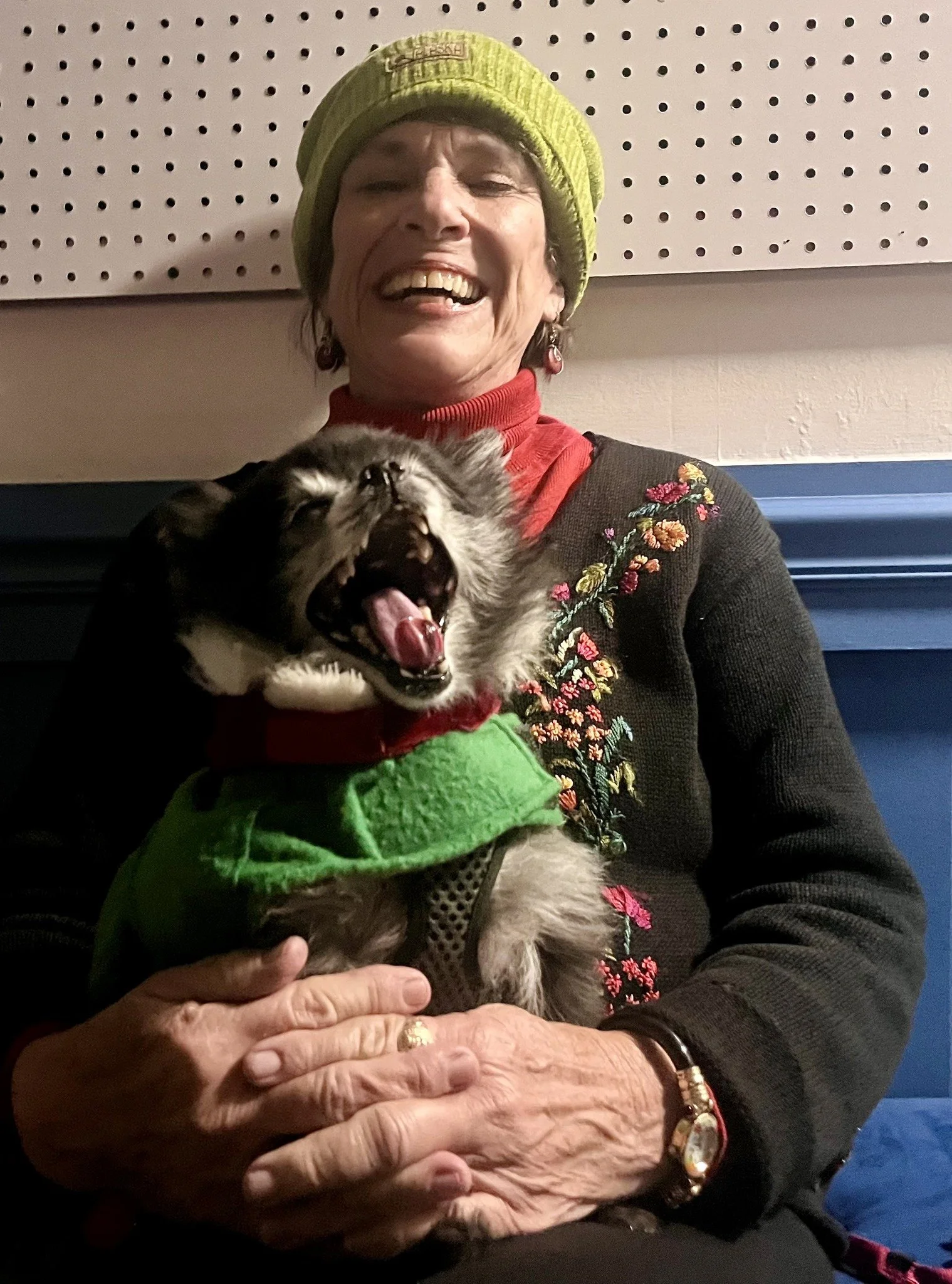
The regulars begin to arrive. Patricia and William secure their favorite table in back. The single ladies gravitate to the stuffed chairs by the window. There’s lovely Toni, and radiant Maris, and sweet Fran with her street-wise Pomeranian, Tito. There’s Nancy and Curt, who plays a mean sax. Our former neighbor, Stan, has brought with him a visiting relative. Femi stops by the bar to donate two bottles of Cabernet. Others leave offerings on the food table. The snacks and beverages are free, but an old-school piggy bank welcomes donations. 

By now, most visitors know that GROW is meat-free, for reasons listed on a sign next to the kitchen (in short because we care about the planet, animals, and public health). To help drive the point home, there is a picture of a pig wearing a flower crown that reads, ransom-note style, KiLL the PAtriaRchy, NoT PiGs

First-timers are as easy to spot as tourists in Rome. They stand in the back or perch on the settee in the hall, taking it all in. The variegated crowd. The raft of musicians up front. The handouts by the door promote meetings and events. The shelves stuffed with history books and biographies. The walls are papered with flyers, postcards, and old posters — No Nukes, ERA YES, Save the Whales, Bob Dylan, Bob Marley, Jimi Hendrix — and portraits of Che, Robert Smalls, Frederick Douglass, Sarah and Angelina Grimké.

A large chart illustrates the state’s gerrymandered legislature, a grim pictograph of our rigged system.
Fran Cardwell with Tito — Photos courtesy of the author

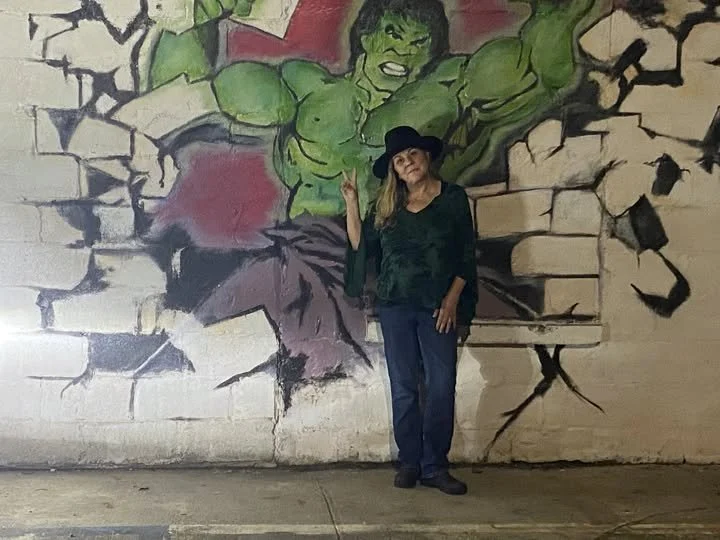
Most of the posters hung in the original GROW, a worker collective that was a hub of progressive activism from the late ’70s through the early ’90s. Longtime Columbia residents will remember the building behind the old ballpark with the mural of the Incredible Hulk smashing through the front wall. 

Started by veterans of the anti-war and anti-nuclear movements, GROW sustained itself by running a cafe and a print shop. It expressed itself by publishing its own journals — Harbinger and, later, POINT, a monthly newspaper that for 10 years happily skewered the Palmetto State’s bad actors and power elite. 

In 1996, GROW started the SC Progressive Network, a coalition of organizations with a shared belief that we are stronger united than separate, when we collaborate, share resources, and show up for each other, even when it’s hard. Especially when it’s hard.

While the Network has evolved over the years, its core mission remains the same: to power a movement for social and political reform that benefits us all, not just the monied few. Politically, we are anti-partisan and choose our legislative battles with care.

Strategically, we focus our time and energy on South Carolina. As we say, “We can’t change DC until we change SC.” 

In 2009, the Network leased the Modjeska Simkins House, keeping offices and holding meetings there for a decade, until the home was converted to a museum. Simkins had mentored and inspired the activists at GROW in the 1980s, so it seemed a perfect fit. And it was while it lasted. 

We were homeless for a while, but after an extensive hunt for a place to call our own, the Network came full circle back to Marion Street, buying the property next door to the Simkins House in 2019 — just in time for the pandemic. 

The timing seemed awful but, in hindsight, the lockdown gave us time to renovate the building properly and the incentive to install a quality AV system to allow for remote meetings and programming. The investment has served the Network well. 

In 2015, the Network launched a school to instruct students of all ages and interests a people’s history of South Carolina — the stories that have been whitewashed or erased altogether — and practical tools for being effective organizers and citizens. We named it the Modjeska Simkins School to honor the woman who showed us how it’s done. Turns out, she had started a leadership institute in the ’40s, with a curriculum eerily mirroring our own. 

In February 2026, we will open enrollment for our 11th session, which will run from March through June. Students from across the state will meet Monday nights in-person at GROW and at satellite sites in other towns, and on Zoom from anywhere. During the semester, the school offers Deep Dives on most Sundays that feature writers, historians, and filmmakers. The programs are free and open to the public. 

It’s last call. It’s been a great ride tonight. Lots of new faces in the audience and onstage. Dickie and Shannon took turns at the keyboard. Seitu did some inspired scat, and Steve wrung the juice out of his flute. Margaret broke hearts with her torch song. Sara torched Elon Musk and “rich people having a ball; rich people fucking us all.” And Cesar, the Louisiana bluesman and harmonica master, broke out his washboard for a call-and-response number that had the room on its feet. 

As the clock inches toward 10, the band launches into “Sugar,” its regular closing number. Nobody gets up to leave, not until the last note is played. Even when the lights go up and the show is over, people linger. 

The band packs up, the helpers have done all they can, and finally the parking lot empties. I take the trash out and roll the recycling bin to the curb. The porch lights are on at the Modjeska House next door. I think about all the people who sat with her there over the years, from Thurgood Marshall in the ’40s to a young Brett in the ’70s. I wonder what she would think of the school, the hippies she mentored. I wonder, too, what she would make of her rebranding. Once called a commie and ostracized from the organization she started, she has now been embraced by the establishment as a civil rights icon.  

I head inside for one last look around. Leisa Marie, a friend from the original GROW days, helps me lock up. Before heading to her car, she gives me a hug and says, “You have built a fine house.” 

I smile and nod. Yes, yes, we have. 

Becci Robbins is Communications Director for the SC Progressive Network.

This article appeared in the Fall 2025 issue of Jasper Magazine.


GROW is located at 1340 Elmwood Avenue in Columbia, SC. Visit GROW for Jazz Workshops on first and third Thursdays and Blues Workshops on second and fourth Thursdays, from 8 – 10 pm. For more information about GROW consult the website at columbiagrow.com.

SC Phil Presents 3rd Annual HOME FOR THE HOLIDAYS - A Celebration of Some of the Midlands' Most Exciting Performing Artists at Christmas!

DECEMBER 18, 2025

KOGER CENTER FOR THE ARTS

From our friends at SC Philharmonic -

The South Carolina Philharmonic presents Home for the Holidays on Thursday, December 18, 2025 at 7:30 PM at the Koger Center for the Arts under the baton of Music Director Morihiko Nakahara. As this concert is a holiday-themed variety show, the orchestra will be joined by singers Cat Galán (Stankface, Boomtown Trio), Edwin Hamilton (SC Jazz Masterworks Ensemble), Katie Leitner (Say Femme) and opera singer Johnnie Felder. The concert includes dance performances from Cola Rep Dance Co. and CCJ Conservatory. Local Elvis tribute Bernie Love closes the first act, and The Columbia Choral Society joins the orchestra for the thrilling second act. Trumpeter Mark Rapp (Cola Jazz) makes an appearance, and Santa will also be on hand for any last-minute requests. This joyful concert is a creative

collaboration between Music Director Morihiko Nakahara and director Chad Henderson, the former Artistic Director of Trustus Theatre and current Marketing Director of the SC Phil. Tickets may be purchased by visiting scphilharmonic.com or by calling the Koger Center Box Office at 803-251-2222.

Home for the Holidays is one of the Midlands’ last large-scale holiday-themed events of the year. This concert is a great way to entertain family and friends who have gathered for the holidays, and for those who are looking for new traditions. Created in collaboration with Music Director Morihiko Nakahara and local theatre director Chad Henderson, this concert is an energetic experience that celebrates the Midlands arts scene.

“This concert is a high-energy night that is a demonstration of the talent in our community,” said Director Chad Henderson. “It’s been such a joy planning this concert every year, and this year we’re returning with an even larger slate of guest performers who are favorites in town. I’m personally excited about our very own local Elvis tribute, Bernie Love, coming on board to close out the first act. We’re going to play Also sprach Zarathustra and do the Vegas opening and everything.” Undoubtedly, this holiday concert will be a great opportunity for audiences to unwind and get into the spirit.

In addition to the fun Elvis portion of the program, audiences can expect to hear holiday classics like The Christmas Song, I’ll Be Home for Christmas, Sleigh Ride and It’s the Most Wonderful Time of the Year.

Opera singer Johnnie Felder and Cat Galán return for an encore performance of The Prayer – which brought audiences to their feet mid-show last year. Mr. Felder will perform a thrilling arrangement of O Holy Night with the orchestra and The Columbia Choral Society. The choir will also join the orchestra for Christmas Canticles and selections from John Williams’ Home Alone score, among others, in the second act of the show.

The South Carolina Philharmonic is committed to performing live symphonic music and providing dynamic educational opportunities in the Midlands. We carry forward a legacy of passion for the music and embrace our responsibility to be a vibrant part of the cultural fabric of our diverse community.

Buy Tickets Here!

CALL for ARTISTS! IN THE MAKING: CONTEMPORARY CRAFT FROM SC a component of HANDWORK 2026: CELEBRATING AMERICAN CRAFT!

From our friends at SC State Museum —

CALL FOR ARTISTS! 

In the Making: Contemporary Craft from South Carolina is a juried exhibition organized by the South Carolina State Museum as part of Handwork 2026: Celebrating American Craft, a nationwide initiative led by Craft in America.  

This exhibition will highlight up to 12 South Carolina-based artists working in fiber, ceramics, wood, metal, glass, mixed media, and other fine craft media. Selected through a statewide open call, participating artists will present newly made works alongside recent creations, offering a look at the breadth and vitality of craft practices in the state today.

Artists for this exhibition will be selected based on the strengths of their submitted portfolios by a panel of jurors. Final works will be chosen during studio visits, with the possibility for the artist to create new pieces specifically for the exhibition. Final selections for the exhibition will be the decision of the curatorial staff of the museum. 

Since opening in 1988, the South Carolina State Museum has celebrated the creativity and craftsmanship of artists working across the state. In the Making: Contemporary Craft from South Carolina continues this legacy as part of Craft in America’s Handwork 2026 national initiative. Artists selected through this open call will represent the depth and diversity of South Carolina’s contemporary craft community.

All submission materials are due on or before Sunday Feb.1, 2026, at 5 p.m. 

Exhibition dates:  Friday October 16, 2026 – April 24, 2027

Opening reception: Thursday October 15, 2026


Interested in applying?
Artist Application(opens in a new tab)


A Message of Appreciation from the Jasper Family

Gratitude is not the only the greatest of virtues, but the parent of all the others. – Cicero

Let’s face it. There’s a lot about American Thanksgiving that is bupkis. From opposing (and propagandistic) theories of the origin story, to “traditional” dishes based on cans of Campbell’s BPA-laden soup, to little kids dodging those creepy uncles who bid them to sit on their laps after dinner, not everything about Thanksgiving is as wholesome and good as subjective history would have us believe. But science shows us over and over that being both thankful and grateful is good for our own mental health as well as the health of the relationships we foster. 

To that end, I asked the Jasper Project board of directors to share the things for which they are all thankful, in their personal lives and in their lives as public servants to the arts. 

I ask you now to indulge us as we share these thoughts with you. 

pictured - Kristin Cobb, Meeghan Kane, and Bekah Rice

I'm so thankful for the creative minds and tender hearts that continue to make this city better, and I'm particularly grateful for the Jasper team for welcoming me with open arms. It has been such a pleasure working with these talented folks. - Meeghan Kane

I am thankful for grace. For friendships that last and those that do not. For having my parents still with me. For my children who continue to make me proud of their choices to live life on their own terms and with an open heart. For the ability to get up every day and brush my teeth, go to the gym, eat a yummy meal, and breathe. For getting to work in the arts… and manage the coolest venue…It really is all a gift. - Kristin Cobb

I’m thankful for my husband, Adam Corbett, and all the other board spouses and partners who support us and work their butts off to help out at events and the wonderful artists we have worked with this year (and previous years)! I appreciate their patience with and kindness toward our board member volunteers, and the opportunity to show their work! The Jasper board for dedicating their time and talents and working so hard to make everything we do happen. I'm excited for the new folks we have joining next year as well and can't wait to see how much we accomplish! - Bekah Rice

pictured - Keith Tolen with family & friends

I’m thankful this year and every year for being a part of this amazing arts community that continues to thrive and contribute to our culture with generous positive energy. I am also grateful to be a part of the Jasper Family! - Keith Tolen 

I’m thankful for creativity - the soul of connection and overcoming differences. - Pam Bowers

I’m thankful for the new, young creative talent that is making Columbia a brighter city to live and create in. - Wade Sellers

pictured - Dick Moons leading a drum session at Jasper’s Degenerate Arts project, June 2025

I am thankful for living in a place that has such a vibrant, diverse & active arts community. I am constantly amazed & grateful for the wealth of talent in this relatively small city. I don't think many of our citizens realize just how fortunate we are. I'm also thankful for my kids,  my beautiful friends and for still being here to appreciate it. - Dick Moons

I am thankful for family and friends. I’m also thankful for the opportunity to share my ideas with the world. - Kwasi Brown

Fish for Thought by Emily Moffitt

I am thankful for my dear friends, family, and my partner-in-crime Dylan! I am also extremely grateful for all of the artists who have allowed me to work with them at Koger or through the Jasper Project. It makes me very happy to think about how we are all improving and contributing to the arts here in Columbia. - Emily Moffitt

pictured - Stan Conine

At this point in my life, I realize how thankful I am for my families (plural): Of course the really close biological one that calls me “Stanley” or ”Dad” or ”Pops.” But also my close family of Vista neighbors and friends who sometimes call me “(censored).” Or just call me. And I am especially thankful for my family of artists and fellow art lovers who helped me realize that I’m not just an art lover, I am also an “artists lover.” - Stan Conine

I have accidentally contrived the perfect retirement, having surrounded myself with visual, graphic, musical, literary,  theatrical and other kinds of artists and can proudly count them as my friends. These are the rewards of a lifetime. I was worried I'd spend my dotage playing pickleball and watching reruns of Barney Miller until I was dead. Instead, I get to write and listen to and watch and celebrate the artists with whom I cross paths on a regular basis. Barney Miller is great and all, but it can wait awhile. Oh: family and food. Those things matter too. Perhaps I take them for granted because they've always been there, which is more than enough to fill a fella's heart. - Jon Tuttle

pictured - Libby Campbell with members of her beloved “thruple” - Becky Hunter and Ellen Rodillo-Fowler

I’m thankful to live in a community which has such a thriving arts community; my closest friendships have evolved from that community. I’m also thankful for the bunch of weirdos who make up the Jasper Board and for  Cindi & the good Doc  who see that a light shines on Midlands artists who might otherwise not be recognized. And ambrosia. - Libby Campbell

pictured - Cindi’s grand-monkeys

Among the many things I’m thankful for, including family and friends and my home at Muddy Ford, I’m also thankful for the talented and committed friends who serve on the Jasper Project board of directors. We have a magazine and a film project and a playwright project and SIX galleries because these devoted people give their time, energy, and talent to a dream I had almost 15 years ago – and they’ve kept that dream alive! I’m also especially thankful this year for the newest member of our family, our fur-baby Jane. And, of course, my grand-monkeys, Sarge and Bobby. - Cindi Boiter

pictured - Janie enjoying my favorite Thanksgiving tradition - the nap!

Two Events Coming Up Celebrating GENERATIONS: 100 Years of Arts at the University of South Carolina

The University of SC’s School of Visual Art and Design is having a birthday - and it’s a big one!

Established in 1925, USC’s School of Visual Art and Design (SVAD) is celebrating it’s 100th birthday this year with two events coming up next week at Columbia Museum of Arts The Loft, as well as at McKissick Museum on the campus of USC.

On Friday, December 5th you’re invited to help celebrate this auspicious occasion by attending a reception in honor of the museum’s exhibition of art from alumni and professors, current and contemporary, titled Generations: 100 Years of Arts at The University of South Carolina. Curated by students under the direction of Susan Felleman and Lana Burgess last spring. The reception is from 4 - 5:30 and is free.

Later, you may join celebrants at our Columbia Museum of Art’s The Loft (1515 Main Street) for an even bigger bash from 6:30 - 9:30. The evening includes live music, food, drink, opportunities to purchase art, and a short talk by Deborah Solomon, New York art critic and authorized biographer of the artist, former Lake Murray resident and USC student Jasper Johns, the artist for whom our little magazine was named. Tickets are required for this event and may be purchased by clicking this link. Please note: there is a sizeable reduction in ticket prices for artists who are self-employed. (Kudos to the event planners for giving this much-appreciated financial break to working artists!)

Jasper congratulates and honors all the members of the SVAD family!

Last Week for Jasper's November Tiny Gallery Featured Artist YYUSRI

Thinking about a Christmas present for the art lover in your circle? Check out the work of YYUSRI, Jasper’s featured Tiny Gallery artist for November. But don’t wait too long! YYUSRI’s art is only up for one more week. And the best part? You can grab this art up without ever having to leave your house. Remember — Art from Columbia’s LOCAL ARTISTS make some of the best presents you’ll ever find!

Read more about YYSURI below —

In the artist’s own words —

I’m based in Columbia, SC, but my home is where the art is. I create to tell stories. As a storyteller, I’m drawn to many forms of expression. It may look like I wear many hats, but it’s really one hat with a very wide brim. Whether I’m illustrating, painting, animating, or producing music, I’m doing the same thing; telling stories.

Stories come in countless forms: pictures, comics, songs, films, or even a voice by the campfire. Growing up, I was captivated by how stories could transport and transform us, revealing new possibilities. Through my work, I aim to show (and teach) that what you can imagine, you can create.

As a full-time artist, every artwork that finds a home brings me closer to realizing my dream project: Our Sun is a Star, an animated coming-of-age story about loss, healing, and escape.

To purchase any of these pieces (and many more not pictured) visit Jasper’s Tiny Gallery as easily as clicking here!

Last Week to Enjoy the Art of JUDY MAPLES - Jasper's Featured Artist at Sound Bites Eatery

This is the last week to check out the art of Judy Maples in the Jasper gallery space at Sound Bites Eatery, just a block off Main Street on Sumter. Maples artworks are beautiful abstractions created using a lovely color palette that almost seems to jump off the walls.

Below, we share the artist’s own words as she reflects on her paintings.


What do these things have in common: soil, puff pastry, music, and my abstract paintings?

Layers.

My painting process is based on instinct, intuition, and emotion. The layers in my abstracts reflect my life experiences and the stories I carry with me. When I start a new canvas, I don’t have a clear plan or a specific image in mind. I allow the painting to evolve naturally, letting each layer guide me to the next. This approach allows me to be fully present in the moment, to respond to the colors and textures as they emerge, and to create something that feels authentic.

The first layer often consists of random marks and strokes of bold colors applied with a sense of freedom and spontaneity. Then I add layers and textures that overlap to create depth and complexity. One of my favorite techniques is to apply a layer of paint and then scrape most of it away, revealing glimpses of the layers beneath. As I add layers, I refine the composition to add depth, complexity, and emotion.

My abstract paintings continue to evolve in the eye of the viewer. Each person sees something different, finds their own meaning in the layers, and adds their own story to the painting. Only then is the painting finished.

My abstracts, with their many layers and textures, have depth and a sense of history, leaving the viewer to think, “I wonder what’s under that top layer?”


Maples’ work will remain up for viewing through Saturday morning, November 29th.

Congrats to Columbia's Koger Center for the Arts - A Grantee of the Levitt Music Series!

Huge Congrats to the Koger Center for the Arts for being a Levitt Music Series Grantee! The Jasper Project is proud to be among the SC organizations that partner with the Koger Center to make it more than just a performance venue, but a true center for the arts. Every Third Thursday patrons can join Jasper on the center’s second tier at our Nook Gallery space where we feature the work of a Midlands-area visual artist as part of The Vista’s regularly scheduled Third Thursday programming. The intimate space offers patrons the opportunity to meet and chat with our featured artists, share a snack, and often hear our artists speak about their work. This is always a free event and we typically go from 5:30 - 7 pm, but it’s always a good idea to check the Koger Center calendar to be sure a performance doesn’t result in a change in time.

While the Koger Center has been offering a program of free events in the lobby and on the outdoor stage for a while now, director Nate Terracio says this is the first time the organization has been awarded a Levitt Music Series Grant. “The grant provides 3 years of support for free outdoor concerts in 2026, 2027 and 2028,” Terracio says, explaining that, “We have hosted both local talent such as: Longtooth, Prettier than Matt, The Ramblers, CammWess, David Rodriguez, and members of the Black Nerd Mafia,” as well as regional and national acts including Claudette King, Clap Your Hands Say Yeah, J Roddy Walston, John Hollier, She Returns From War, and Indianola.

“The Koger Center for the Arts is beyond excited that Columbia has been chosen as the first city in South Carolina to be recognized and funded by a Levitt Music Series Grant and we are thankful to the community and individuals that supported our efforts and took the time to vote for us,” he continues. “We look forward to expanding our free outdoor concert series through this grant to include spring and fall concerts.  As Columbia’s center for the arts, we want everyone to feel welcome and hope to bring the whole community together through music both inside and outside.”

For more about the grant please refer to the press release issued by the Levitt Foundation: “The Levitt Foundation, a national social impact funder supporting the largest free outdoor concert series in America, today announced the largest number of Levitt Music Series grant recipients in its history—providing 66 communities with multi-year grants, up to $120K each.

Levitt Music Series Grants are an exciting, multi-year matching grant program bringing the joy of free, live music to towns and cities across the country. Each Levitt Music Series location presents 7-10 free outdoor concerts per year, injecting new life into underused public spaces and creating joyous, inclusive community destinations. Reflecting the Foundation’s commitment that all Levitt projects be community-driven, the top 50 finalists were selected through public voting in September 2025 (via online and text to vote). The Levitt Foundation then conducted a comprehensive review process of all finalists to determine the Levitt Music Series grant recipients.

The Levitt Foundation will be awarding over $7 million dollars over three years to the nonprofits presenting Levitt Music Series, supporting 34 new grantees and 32 returning grantees to bring free outdoor music to their communities in 2026, 2027, and 2028. Also new this grant cycle are funding partnerships with state agencies—in Tennessee and Mississippi—to bring even more free outdoor concerts to their communities.

“The Levitt Foundation is thrilled to announce the communities across the country receiving Levitt Music Series grants, and we congratulate all the new and returning Levitt grantees. We know from decades of supporting free concerts in public spaces how the power of free, live music brings friends, families, and neighbors of all ages and backgrounds together, strengthening the social fabric and economic vitality of communities,” said Sharon Yazowski, President & CEO of the Levitt Foundation. “We are also excited that our partnerships with Tennessee and Mississippi are supporting additional communities in those states—a model we hope will inspire other states throughout our nation for future collaborations to bring free, outdoor concerts to their towns and cities.”

From the print issue: Jasper Presents Ceramicist Megan Tapley at Coal Powered Filmworks for Vista Lights!

Tapley’s work always falls into the category of being socio-political in some aspect. She sees the art scene as a proper catalyst for change, with their art being a factor in facilitating it.

Jasper is once again proud to participate in the 2025 Vista Lights celebration and, this year, our featured artist is ceramicist Megan Tapley. A resident artist at Gemini Arts, Tapley will be setting up shop at Coal Powered Filmworks (home of Jasper’s filmmaker extraordinaire and board of directors president Wade Sellers) offering some great items to help you tackle your Holiday gift-buying list. The festivities get under way at 6 pm and Coal Powered Filmworks is located at 1217 Lincoln Street, a couple down from Mike Brown Contemporary and across the street from the Blue Marlin.

Read our article below about Megan Tapley, written by Emily Moffitt, which originally appeared in the fall issue of Jasper Magazine which is on newsstands now.


An Unconditional Approach to Life with Megan Tapley

By Emily Moffitt


Following a traditional lifestyle has never been in the cards for Megan Tapley. Living life to the fullest for them means living a bit unconventionally, but that never stood in the way of them pursuing their own aspirations: making a career out of art.

Megan Tapley, pronouns she/they, graduated from Clemson University in 2024 with a B.F.A. in Ceramics. This was not always their medium of choice, though. “I grew up in many accelerated art programs, which introduced me to ceramics at a young age,” says Tapley. “However, I did not pursue ceramics until college.” Tapley finds that her artistic practice is best when they balance their time between multiple disciplines, so they also engage in collaging, filling out their sketchbook, and building sculptures when not focusing on their ceramics. They are inherently driven to be creative, and as such they find any outlet they can to express their creativity.

However, regardless of the medium, Tapley’s work always falls into the category of being socio-political in some aspect. She sees the art scene as a proper catalyst for change, with their art being a factor in facilitating it. Much of Tapley’s portfolio revolves around femininity, thus leading to a body of work that focuses on the female form, reproductive rights, and the role of women in the South. Tapley says, “I feel led to make this work because of my own personal identity as a woman in the South, but I also feel led to make this work to open the conversation up.” The conversations she references are meant to be inviting rather than polarizing, especially among women. Her senior exhibition included a wide variety of vessels that represented different female forms and the desire for bodily autonomy, in a socio-politically charged statement. These differences in form, shape, and size are all meant to bridge gaps and spark up conversations of intersectionality and change as according to Tapley, “I chose to make my work inviting rather than polarizing in hopes that we can all find common ground amongst the issues we face as women.”

Tapley was born and raised in Irmo and found themself returning to the Midlands after finishing their undergraduate degree. The excitement of being a Gen Z artist in a growing community allured her, creating in them a sense of confidence in seeking out a “riskier” life, separate from the stable, 9-to-5 lifestyle other generations seem to encourage the next generation to pursue. “I think being a young artist in a growing community is a good thing,” says Tapley. “I’ve been able to gain a lot of opportunities in the last three months by being willing and able to help grow and foster the arts community here.”

Despite just starting their post-grad career, Tapley has already made great strides by becoming a resident artist at Gemini Arts and has been elected as the inaugural Gemini Arts President. The position comes with a heavy workload but is an optimal role to produce cool opportunities for her fellow artists in the studio. Making the effort to involve themself in the community is the kind of advice that Tapley offers any other young artist trying to participate in Columbia’s creative landscape. “My biggest advice is to apply to everything,” says Tapley. “The worst someone can tell you is no, and you never know where an opportunity will lead you.” Of course, Tapley also warns of the problems with saying “yes” to everything, and that it is okay to only pursue chances that are in your best interest and push your career further forward.

Tapley knows that the path of an artist is not always the easiest to take. Facing the reality of the “starving artist” narrative that many peers still harbor helped Tapley understand the importance of having true allies in your corner, ones that do support you and your craft unconditionally. Tapley says, “I feel that having people around me who question my career choices is just something that will always be an obstacle, so my way of overcoming this has been to unconditionally believe in myself.” Adopting an unwavering sense of confidence is key advice for anyone trying to break into the art scene, especially younger artists. Tapley has proven through their growing role at Gemini Arts and consistent booking of arts exhibitions that they have internalized key experiences and connections and utilized them to further their career.

In-progress art from Megan Tapley

They say, “I have learned to take feedback from those who have pursued a career in the arts, rather than giving too much attention to those who do not understand the life and career I have chosen to lead.”

Tapley is an active member of the Gemini ceramics community, and a staple in bringing awareness to the power of political commentary through art, especially for women of all ages.

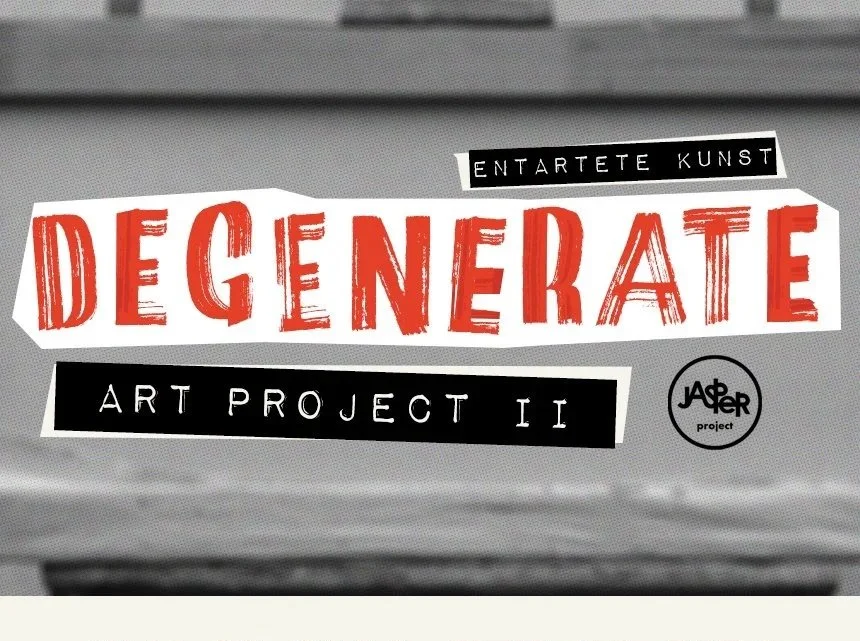
From the print issue -- DEGENERATE ART PROJECTS I & II

“We proudly reclaim our art—protest art in defiance of the current administration’s attempts to remove, censure, and redefine art and its purpose—"Degenerate Art” in solidarity with both historical and contemporary artists who work or have worked to maintain our first amendment rights of freedom of speech and expression.”

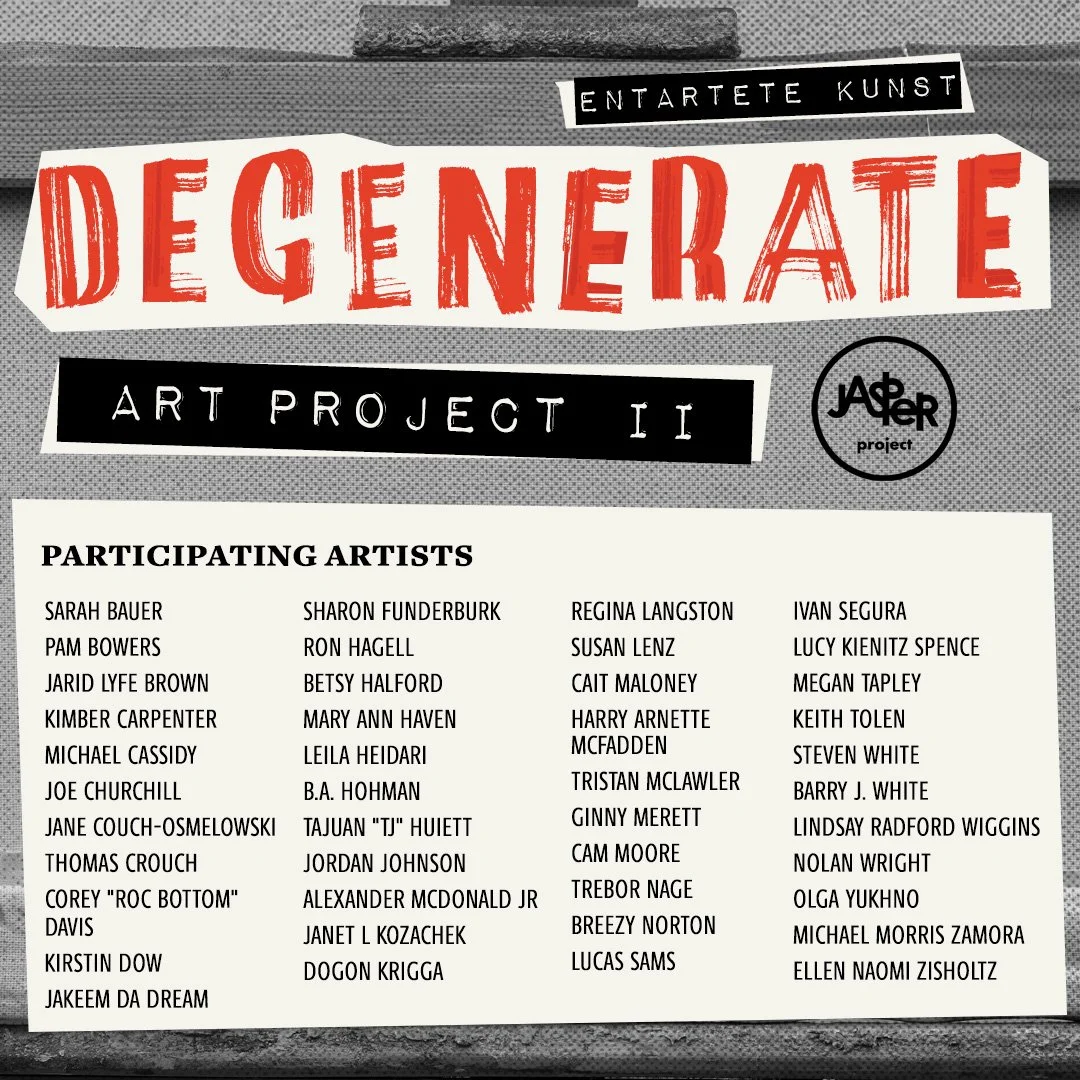
Degenerate Arts—Entartete Kunst—I and II

By Cindi Boiter


Sometimes you just have to say what you’re thinking. You have to get it out there, one way or another. You have to express the fire of frustration, anger, and disappointment that can rage within you, as well as those still-hanging-on, deep-rooted beliefs that it can be better. It has been better. Our country has been better and can be better again. These sensations are complex and difficult to manage for all of us.

Luckily, we have artists.

Art is the tool we humans use to attempt to reconcile our profound and complicated responses to a world that doesn’t always give us the peace we crave. The peace we once took for granted. The process of creating art, be it dance, theatre, or music, visual art, or the written word, not only soothes the artist but it helps the recipient of the art, the viewer, the reader, feel seen and heard as they wrestle with the same conflicts an unbalanced world stirs inside them. It helps the recipient to better comprehend where we are right now, as a culture, and it helps us know that they we not alone.
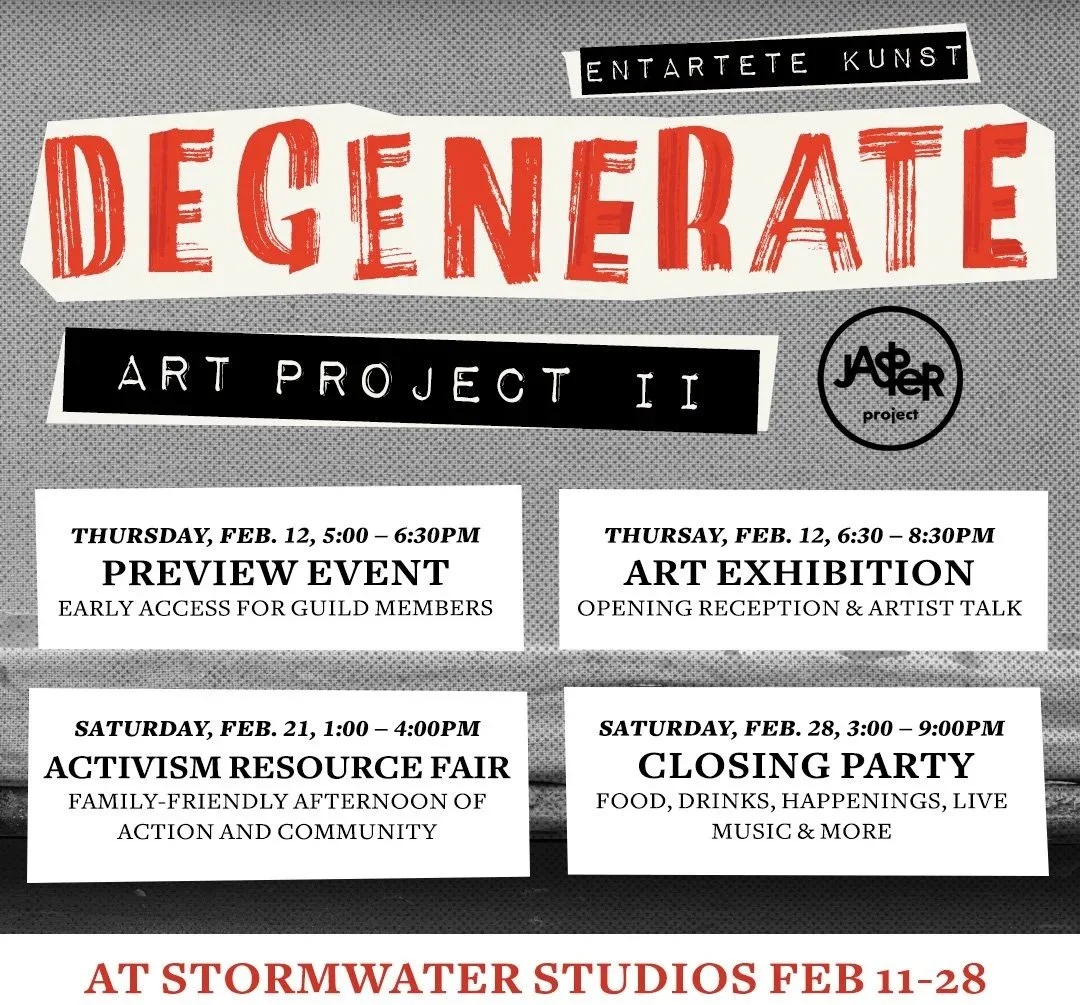
This is why the Jasper Project originated the Degenerate Art Project in the summer of 2025 at Stormwater Studios, and it is why we’re bringing this unique project back in January 2026 at Gemini Arts.

Degenerate Arts II offers an open call for visual artists as well as performing or written word artists who want to propose programs that they would like Jasper to help implement.

Why do we call it “degenerate art?” In his essay printed in the current issue of Jasper Magazine, professor and Jasper Magazine poetry editor Ed Madden identifies the similarities between Hitler’s purge of art that did not represent the cultural ideology he promulgated—an ideology we now recognize as fascist—and the current administration’s attempts to dictate, control, and suppress art via a “politics of culture.” As Madden writes, in July 1937, “Nazi culture warriors had searched 32 of Germany’s public museums, determined to purge them of any work they considered undesirable because they were incompatible with Nazi values.” Hitler and Goebbels called the exhibition of this “undesirable” art “Degenerate Art,” or “Entartete Kunst” and juxtaposed it against an exhibition of predominantly representative art, of which he approved, and titled “Great German Art” or Grosse Deutsche Kunstausstellung.

We proudly reclaim our art—protest art in defiance of the current administration’s attempts to remove, censure, and redefine art and its purpose—"Degenerate Art” in solidarity with both historical and contemporary artists who work or have worked to maintain our first amendment rights of freedom of speech and expression.

CALL FOR ART FOR DEGENERATE ART PROJECT II EXTENDED UNTIL MIDNIGHT SATURDAY NOVEMBER 22ND!

I’ve always maintained that we don’t fully know the history of an event or a period of time until we know how the artists interpreted it. To that end, we created the first iteration of our Degenerate Arts project to provide a concerted platform for Columbia’s artists to express their responses to our country’s current socio-political situation. We also wanted to bring our local arts community together both physically and in spirit during this challenging time in order to support and encourage one another. And we hoped to preserve for posterity the SC Midlands’ artistic interpretation of this unique and disturbing time in history.

More than twenty visual artists participated in the Degenerate Arts Project in June. It was exciting to see the work, some of it satirical like Robert Airial’s cartoons of the president as a present-day Mussolini and  the same man removing the letters M and E from the word America to simply spell ME. Some was jarring and foreboding, like Eileen Blyth’s found art sculpture of a child’s old doll in a rusty oven. And some of it was incisive and incredibly current like Marius Valdes’ huge painting of a masked ICE agent with a word bubble reading “Just Following Orders.”

Pictured - poet Ed Madden stands before Marius Valdes’s painting “Just Following Orders” during a protest poetry reading in June 2025

Eileen Blyth - Artist

Portrait and assemblage artist Kirkland Smith says, “Being part of the Degenerate Arts project reminded me how powerful art can be in shaping the way we see one another.” She continues, “I appreciated the opportunity to portray a polyamorous group of four beautiful transgender women with quiet dignity, reclaiming a narrative that has been twisted for political reasons. The exhibition created a space for empathy in a world that is forgetting how to listen.”

Kirkland Smith pictured with her painting and her daughter at the Degenerate Art Project I in June 2025

While our first project focused on visual arts, poetry, a little music, and activism opportunities, we plan for our 2026 project to include additional arts disciples and we are excited to hear from dance, theatre, and more literary artists about what you’d like to contribute.

While the 2025 project lasted less than a week, the 2026 project will last three weeks, giving all of us ample time to be seen and heard.

And while the first project was structured as an invitational exhibition, Degenerate Arts II offers an open call for visual artists as well as performing or written word artists who want to propose programs that they would like Jasper to help implement.

For more information on how to submit a proposal for Degenerate Art II please see our CALL FOR ART at the Jasper Project website.

CALL FOR ART FOR DEGENERATE ART PROJECT II EXTENDED UNTIL MIDNIGHT SATURDAY NOVEMBER 22ND!

This article previously appeared in the fall 2025 issue of Jasper Magazine, on newsstands now.

Alex Ruskell & Les Merry Chevaliers Invite You to THE WORLD'S MOST HANDSOMEST ART RECEPTION

Join visual artist Alex Ruskell on Wednesday December 3rd at 6 pm at The Hallway: Community Art Gallery at 701 Whaley for the opening reception of his exhibition.

Special LIVE performance by Les Merry Chevaliers!

The artist Alex Ruskell with Les Merry Chevaliers

From the print issue - REVIEW: THE WEIRD GIRL, Weirdness Becomes Witness—And a Way to See Our Own City Clearly

By Christina Xan

Carla Damron writes with one foot in the world of fiction and the other in the very real, very personal world of social work. In Columbia, SC where Damron herself is deeply rooted, her books feel less like imported thrillers and more like dispatches from our own streets. Her last novel, The Orchid Tattoo (Koehler Books, 2022), introduced readers to Georgia Thayer, a social worker caught up in a case involving human trafficking. With The Weird Girl (Stillwater River Publications, 2025) Damron continues Georgia’s story, this time shifting the focus to the fentanyl epidemic. The message is clear: these crises don’t just happen out there. They are happening here, woven into the fabric of Columbia. And even more striking, these crises don’t just happen but are willfully created and supported.

The plot begins with a party. Sara Clark, a high schooler, leaves the Hawthorne family’s gathering impaired by fentanyl and is struck by a Hawthorne car. Who was behind the wheel remains unclear at first, and the uncertainty becomes central to the novel’s unraveling. It looks at first like a teenage tragedy compounded by privilege, the kind of scandal that might be swept aside by lawyers and money. But in Damron’s telling, this hit-and-run becomes the key to a much larger story about how fentanyl seeps into schools, families, and emergency rooms. By the time Sara is stabilized in the ER where Georgia works, we’ve already seen this community is tainted: Cooper’s father Fletcher, a solicitor with political ambitions, will do anything to protect his son, even if it means leaning on Marcus Landry, a local drug boss. What follows isn’t so much an investigation as a slow peeling back of how deep the rot goes.

As in The Orchid Tattoo, Georgia is the heart of the novel. She is a foster mother as well as a social worker, and that dual role makes the crisis achingly personal. Her teenager Tessa hovers at the edges of temptation, just one bad decision away from the ER cases Georgia sees night after night. And Georgia herself isn’t a flawless hero: she struggles with the stigma of her own mental health history, and DSS officials question whether she is “fit” to foster at all. That tension—between how institutions judge and how individuals care—gives the book its power.

Pulling from her own experience in care work, Damron writes in short, fast-moving chapters that keep the pages turning. Her style isn’t about excess lyricism or flourish but about clarity and momentum. Conversations carry much of the weight, and sometimes you can feel the exposition slip in a bit too neatly. But the accessibility is the point: the book is designed to move, to pull you through the overlapping crises with emotional immediacy. She also shifts perspectives, weaving between Georgia, the teenagers, the Hawthornes, and even those entangled in the drug trade. That kaleidoscopic structure keeps the story from narrowing into a single vantage point and forces us to see the crisis as it ripples across every layer of the community. The result is a thriller that doesn’t just keep you hooked but keeps you alert to what’s at stake. You don’t forget that Georgia’s exhaustion mirrors that of real ER staff, or that Sara’s overdose echoes the tragedies that have played out in real schools.
What continues to help The Weird Girl stand out from more formulaic crime fiction is how it blends genre with social realism. The bones of a police procedural are here—an abduction, a cover-up, a climactic raid—but Damron keeps pulling us away from the lone-wolf detective narrative. Georgia is no hard-bitten cop; she’s a woman whose strength lies in care, in community, in refusing to look away from suffering. Even the simmering tension between her and Detective Lou, which could feel like a genre cliché, is rooted in trust and mutual reliance rather than sweeping romance. The book isn’t interested in distracting us with passion so much as reminding us that these characters are human, bruised and still reaching for connection.

The strongest thread of all is the way Damron interweaves the personal and the systemic. On one side, our characters each have their own struggles: Georgia holding onto her foster daughter, Sara fighting for her life, Lily Grace abducted after witnessing too much, Tessa wavering between rebellion and trust. These are characters—often women and girls—who do not fit, whose weirdness becomes their power. Their voices are distinct and their struggles tangible, which prevents the fentanyl crisis from collapsing into abstraction. On the other hand, you have the structural forces: Fletcher’s backroom deals, Marcus’s grip on the supply chain, DSS threatening to rip a family apart on a technicality. What could feel like two novels occurring side by side, Damron expertly merges together through her cast of distinct characters and interactions. A party overdose ripples into political corruption, a vigilante firebombing underscores the desperation of citizens abandoned by institutions, and every small story reveals the larger system grinding in the background. The book doesn’t let readers rest with the easy conclusion that drugs are bad, one we can easily separate ourselves from. Instead, it insists we reckon with how entrenched power protects the pipeline, and how entire communities are complicit in the harm.

Reading The Weird Girl feels urgent because Damron refuses to exoticize the crisis. She writes Columbia as Columbia, with no comforting distance. And while that specificity makes the book hit especially hard for those of us here, its urgency isn’t limited by geography. The networks of privilege, corruption, and exploitation Damron exposes are recognizable in cities and towns everywhere. The point isn’t just that it happens here, it’s that it can, and does, happen anywhere. The result is a thriller that doesn’t just entertain but unsettles, reminding us that these networks of corruption and compromise are not only possible but present. It’s a crime novel that asks readers to face the realities behind the headlines, and to consider what it means to fight for care in systems designed to fail.

If The Orchid Tattoo announced Georgia Thayer as a protagonist worth following, The Weird Girl confirms it. Damron has carved out a space in the crime genre that is less about puzzle-solving and more about moral witnesses, less about lone heroes and more about collective survival. For readers in Columbia, the novel lands close to home, but its reach extends well beyond these stories could unfold in any city where privilege shields the powerful and fentanyl devastates the vulnerable. Damron’s accomplishment is to make us see both at once.


Christina Xan is a former intern and member of the board of directors for the Jasper Project and is currently assistant professor of English at Northwestern Oklahoma State University.

The original version of this review appears in the Fall 20025 issue of Jasper Magazine.

REVIEW: A Heartfelt and Hilarious Start: Second Samuel Kicks Off Columbia Soda City Theatre’s First Season by Jane Turner Peterson

Second Samuel is the kind of show that reminds you why community theatre matters. It makes you laugh, makes you think, and makes you feel connected — to the characters, to the town, and to each other. -JTP

Columbia’s newest theatre company has officially arrived — and what a debut! Located inside Brookland United Methodist Church in West Columbia, Soda City Theatre launches its very first season on a high note with Second Samuel, delivering a show that’s both laugh-out-loud funny and surprisingly moving.

Directed by Jeff Sigley, Pamela Parker’s Second Samuel takes us to a small Georgia town in the 1940s, where life seems simple… until it isn’t. When a beloved resident, Miss Gertrude, passes away, her friends and neighbors discover a secret that rocks their little community to its core.

This play may be set in another time, but its themes are as relevant as ever. One of the cast members, Ripley Thames, summed it up perfectly — Second Samuel touches on “the trifecta” of issues that still challenge us today: homophobia, racism, and prejudice toward people with disabilities. And somehow, the show manages to explore all of that with humor, warmth, and a whole lot of heart.

Sigley’s direction really shines here. He uses the stage cleverly to create three locations — the Bait and Brew, the beauty salon, and Miss Gertrude’s front porch — and the smooth scene transitions, supported by smart lighting, keep things flowing beautifully. The set design makes great use of the space, and the period-appropriate costumes and props (kudos to Joanne Shaw and team!) really help transport the audience to the 1940s.

Now, let’s talk about this cast — because hats off here.

First, keep an eye on Cash Conroy. His performance as B Flat, the young autistic man who narrates the story, is simply stunning. He brings so much heart and honesty to the role, guiding the audience through the story with charm and depth. It’s no surprise he’s already been in several local youth productions — this young actor is definitely going places.

The rest of the cast is just as strong. Debra Leopard is a joy as Omaha Nebraska — her timing is impeccable, and it’s wonderful to see her back on stage. Nathan Wright had the audience in stitches as June Cline, the town caretaker, with his expressive reactions and storytelling flair. Ripley Thames made Mr. Mozel perfectly intolerable (in the best way), and Bill Arvay brought a grounded, easy energy as Doc.

In the beauty shop scenes, Gayle Stewart (Marcella) and Ginny Walker (Ruby) were a hoot, trading zingers, and sass with Tammy Smith as the bigoted Jimmie Dean. And rounding out the Bait and Brew gang — Roderick Haynes (U.S.), Mark DiNovo (Frisky), and Barry Smith (Mansel) — each added their own spark to the mix.

All in all, Second Samuel is the kind of show that reminds you why community theatre matters. It makes you laugh, makes you think, and makes you feel connected — to the characters, to the town, and to each other.

If this production is any indication, Soda City Theatre has an exciting road ahead. Here’s to a fantastic start and many more stories to come!

Catch Second Samuel at Columbia Soda City Theatre before it’s gone. Performances run November 8, 13-15 at 7:30 pm and on Sunday, Nov. 9 at 3:00 pm. For tickets and more information, please visit their website at sodacitytheatre.com.


Southern Exposure New Music Series Concert Presents Scenes from PERFECT LIVES

The Southern Exposure New Music Series’ second concert of 25-26 presents scenes from Robert Ashley’s quirky 1980s “TV opera” Perfect Lives, a multi-media show led and with music by USC faculty composers

Greg Stuart and David Kirkland Garner

featuring Ed Madden as the Narrator

Greg Stuart and David Kirkland Garner

From our friends at The USC School of Music

Experimental composer Robert Ashley’s seminal work Perfect Lives, an “opera” (of sorts!) about bank robbers, cocktail lounges, and reincarnation (sort of!), was first produced for television in 1984. Since then it has gained a cult following and been called “nothing less than the first American opera, written within an American language using various American attention spans …” (Fanfare).

Southern Exposure’s special presentation of three scenes from Perfect Lives is led by USC faculty composer-performers Greg Stuart and David Kirkland Garner, who contribute the music (the sometimes-inscrutable text is by Ashley) and play alongside USC’s New Sounds Quartet. USC English language and literature professor Ed Madden, former poet laureate of Columbia, [& Jasper Magazine Poetry Editor!] is featured as narrator.

This multi-media program also features a video by Greg Stuart, and includes a related visual art display by Columbia painter [& previous featured artist in Jasper Magazine & Jasper Galleries] Mary Ann Haven.

This FREE concert – no tickets or reservations required, general admission seating – is on Friday, November 14 in the USC School of Music Recital Hall, 813 Assembly St., Columbia.

For more information, visit/contact: Southern Exposure New Music Series